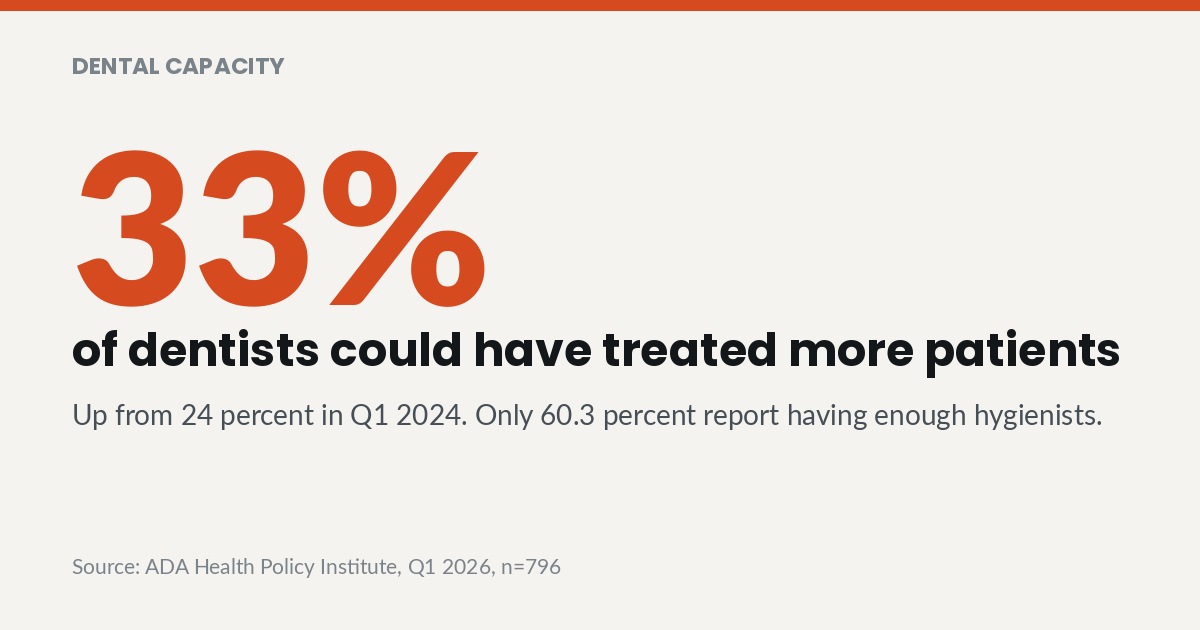
Dental office management now has a capacity problem that looks like a demand problem. ADA Health Policy Institute data for Q1 2026 shows 33 percent of dentists report they are not busy enough, while only 60.3 percent report having enough hygienists. The empty chair and the unfilled hygiene role are usually the same problem.
Two numbers from one survey, usually read apart
The ADA Health Policy Institute publishes both findings in the same quarterly release. In Q1 2026, 33 percent of dentists said they were not busy enough and could have treated more patients, up from 24 percent in Q1 2024. The same survey, drawing on 796 responses, found 60.3 percent reported having enough hygienists.
Those two findings usually appear in separate summaries and separate conversations. Read together they describe a practice with open chair time and no clinician available to fill it. Idle capacity and an unfillable clinical role are not independent facts.
The distinction changes what a practice should spend money on. A practice reading idle chairs as weak demand buys new patient advertising. A practice reading the same signal as a labor constraint fixes the schedule and the staffing model instead.
Supporting evidence sits in the same ADA HPI release. ADA HPI found 73.5 percent of dentists reported enough dental assistants and 79.3 percent enough administrative staff in Q1 2026. The shortage concentrates in the clinical role that generates hygiene production rather than spreading evenly across the practice.
The recruiting market behind the gap
Dental practices are not passively accepting the shortage. ADA HPI reports 37.6 percent of dentists recruited a hygienist in the three months before the Q1 2026 survey. Of those recruiting, 90.5 percent rated the process very or extremely challenging.
Assistant recruiting follows a similar pattern with less intensity. ADA HPI found 36.7 percent recruited a dental assistant and 69.8 percent of those called it very or extremely challenging. Nearly every practice attempting to hire clinical staff is finding the market difficult.
The reason given is supply rather than price. ADA HPI reports 66.5 percent of dentists cited not enough applicants as the primary hygienist recruiting barrier, against 36.8 percent citing demand for high wages and benefits. A shortage of applicants does not respond to a wage increase the way a shortage of willing applicants does.
The benefit structure tells part of the story. ADA HPI found 42.6 percent of practices offer health insurance to staff in Q1 2026. A practice competing for a scarce clinician without offering health coverage is competing on wage alone against employers that do not have to.
The composition of the gap matters for hiring plans. ADA HPI puts administrative staffing at 79.3 percent adequate and assistants at 73.5 percent, against 60.3 percent for hygienists. A practice responding to the shortage by hiring at the front desk has solved a problem it did not have.
Owners frequently ask whether the shortage is temporary. Nothing in the recruiting data suggests a supply response is underway. When 66.5 percent of recruiting dentists point to applicant scarcity rather than wage demands, the pipeline itself is the constraint, and pipelines take years to refill.
Why the new patient budget is the wrong lever
Idle chair time reads as a marketing problem to most owners. The demand data does not support that reading. ADA HPI puts the new patient appointment wait time at 12.4 days in Q1 2026, down about two days from Q1 2024.
Shorter waits mean the schedule already has room in it. A practice with open availability and a marketing campaign will convert new patients into appointments the hygiene schedule cannot support. The bottleneck moves from acquisition to delivery without ever appearing in the marketing report.
The resulting failure mode is specific and costly. New patients arrive, complete an exam, and get placed on a hygiene recall the practice cannot honor within a reasonable window. Those patients leave through the back door while the front door spend continues.
Employment data confirms the sector is hiring rather than shrinking. BLS Current Employment Statistics for May 2026 put employment in offices of dentists at 1,062,300, up 1.7 percent year over year. Practices are adding people and still reporting they cannot fill the roles that matter most.
How the two constraints compound over a year
Hygiene is not only a revenue line on the schedule. It is the diagnostic channel through which most restorative treatment gets identified and planned. A practice short a hygienist loses the appointment where treatment planning normally happens.
The effect arrives with a delay, which is what makes it hard to see. Restorative production falls a quarter or two after hygiene coverage slips, by which point the owner has attributed the decline to the market. The causal chain runs backward from the schedule rather than forward from demand.
Adding new patients into that state makes the arithmetic worse rather than better. Each new patient consumes an exam slot and generates a recall obligation the practice cannot meet. The backlog grows, recall compliance falls, and the existing patient base absorbs the shortfall first.
ADA HPI data shows the idle capacity figure rising from 24 percent in Q1 2024 to 33 percent in Q1 2026. Over that same window, wait times fell and employment in offices of dentists rose. A sector adding staff while reporting more idle capacity is describing a mismatch between who gets hired and what is needed.
Wages are the visible lever and they are already moving
The wage picture explains why owners feel squeezed from both directions. The ADA HPI Survey of Dental Practice for 2025 puts the average hygienist hourly wage at $49.20, up 2.9 percent year over year, with full-time hygienists at $48.80. Average dental assistant wages reached $25.30, up 4.5 percent, with expanded-function assistants at $29.90.
That annual survey carries a 1.9 percent response rate, which is worth stating plainly. The figures work as directional benchmarks rather than as precise market rates. Practices setting compensation should read them alongside local market evidence rather than in place of it.
The monthly federal series points in the same direction. BLS Current Employment Statistics for May 2026 put average hourly earnings for production and nonsupervisory staff in offices of dentists at $34.75, up 4.1 percent year over year. Two independent sources showing wage growth in the same range is a real signal.
Real wage growth is a separate question from nominal growth. ADA HPI's State of the US Dental Economy for Q1 2026 describes dental staff wage growth as roughly zero in real terms. The trailing twelve month figure was nominal 2 percent against 2 percent inflation. Staff are not gaining ground, and owners are still paying more each year.
That combination explains why a pure wage response does not resolve the shortage. Everyone is raising wages, so relative position barely moves. Practices that win clinical hires compete on schedule, benefits and working conditions rather than on hourly rate alone.
Redesigning the staffing model instead of the marketing budget
The practical work sits in scheduling and role design. A hygiene schedule built around a single fixed appointment length wastes capacity on patients who need less and creates overruns on patients who need more. Practices that segment recall intervals by clinical risk recover chair time without hiring anyone.
Cross-training expands the assistant pool
Expanded-function assistants extend what a practice can deliver without a hygienist in every operatory. The ADA HPI Survey of Dental Practice for 2025 puts expanded-function assistant wages at $29.90 against the $49.20 hygienist average. State practice acts govern what is permitted, and the answer differs enough that no general rule applies.
Benefits are a recruiting instrument, not an expense line
With 42.6 percent of practices offering health insurance according to ADA HPI, a benefits package is a differentiator rather than a baseline. The cost is real, and the alternative is an unfilled operatory generating nothing at all. Practices that price the vacancy against the benefit cost reach a different conclusion than practices pricing the benefit alone.
Retention beats recruiting in this market
With 90.5 percent of recruiting dentists calling the hygienist search very or extremely challenging, the cheapest hire is the one already employed. Turnover in a scarce role costs weeks of lost production on top of the recruiting effort itself. Owners who cannot explain why their last clinical departure happened are managing the wrong end of the problem.
Owners who want the analysis done properly should treat it as an operations question rather than a marketing one. Chair use, provider schedules, recall compliance and staffing ratios belong on one page together. Practices needing outside help building that view often start with a management consulting engagement focused on operational capacity rather than another marketing vendor.
The jump from 24 percent to 33 percent of dentists reporting idle capacity in two years is not a demand story. Patient demand did not fall while wait times shortened and employment rose. What changed is the ability of a practice to convert existing demand into delivered care.
That reframing changes the budget conversation for the year. A dollar spent on hygiene capacity, schedule design or clinical retention returns more than a dollar spent attracting patients the practice cannot see. The constraint sits on the supply side of the operatory, and no marketing plan can reach it.
Frequently Asked Questions
How do I tell whether my open chair time is a demand problem or a staffing problem?
The test is whether the practice could deliver more care if a patient appeared tomorrow. A schedule with open operatory hours but no available hygienist is a capacity problem regardless of how it reads on a production report. ADA HPI data for Q1 2026 shows 33 percent of dentists report they are not busy enough while only 60.3 percent report enough hygienists. Practices should map open chair hours against staffed clinical hours before approving any new marketing spend.
Should my practice raise hygienist wages to fill the role?
Wage increases address the wrong barrier for most practices. ADA HPI found 66.5 percent of dentists cited not enough applicants as the primary hygienist recruiting barrier, against 36.8 percent citing demand for high wages and benefits. Raising pay in a market where every employer is raising pay changes relative position very little. Schedule flexibility, benefits and working conditions move candidates further than an hourly adjustment does.
Is it worth investing in expanded-function dental assistants?
Expanded-function assistants extend clinical delivery at a materially lower wage point. The ADA HPI Survey of Dental Practice for 2025 puts expanded-function assistant wages at $29.90 against a $49.20 average for hygienists. State practice acts determine which procedures are permitted, and the variation is wide enough that each practice must check its own rules. That survey carries a 1.9 percent response rate, so the wage figures serve as directional benchmarks rather than precise market rates.
How should my practice be measuring chair use?
Use should be measured against staffed clinical hours rather than against building hours. A practice open five days with hygiene coverage on three is running at full clinical capacity while looking idle on a facility-hours basis. Tracking scheduled hygiene hours, completed hygiene hours and open recall gaps gives a truer picture of capacity. The distance between those figures is the production a practice can recover without hiring anyone.
Does a shorter new patient wait time mean the practice needs more marketing?
Shorter waits indicate available appointment slots rather than weak underlying demand. ADA HPI reports new patient appointment wait time at 12.4 days in Q1 2026, down about two days from Q1 2024. Availability created by schedule gaps rather than by added capacity will fill and then overflow into a hygiene backlog. Practices should confirm the recall schedule can absorb new patients before spending to attract them.
What is the first operational change a short-staffed practice should make?
Recall interval segmentation returns the most capacity for the least investment. Assigning hygiene intervals by clinical risk rather than by a uniform default frees appointment time for the patients who need it. The second change is a documented retention conversation with every clinical employee, since ADA HPI found 90.5 percent of recruiting dentists rated the hygienist search very or extremely challenging. Replacing a clinician in that market costs far more than keeping one.
No comments:
Post a Comment
Note: Only a member of this blog may post a comment.