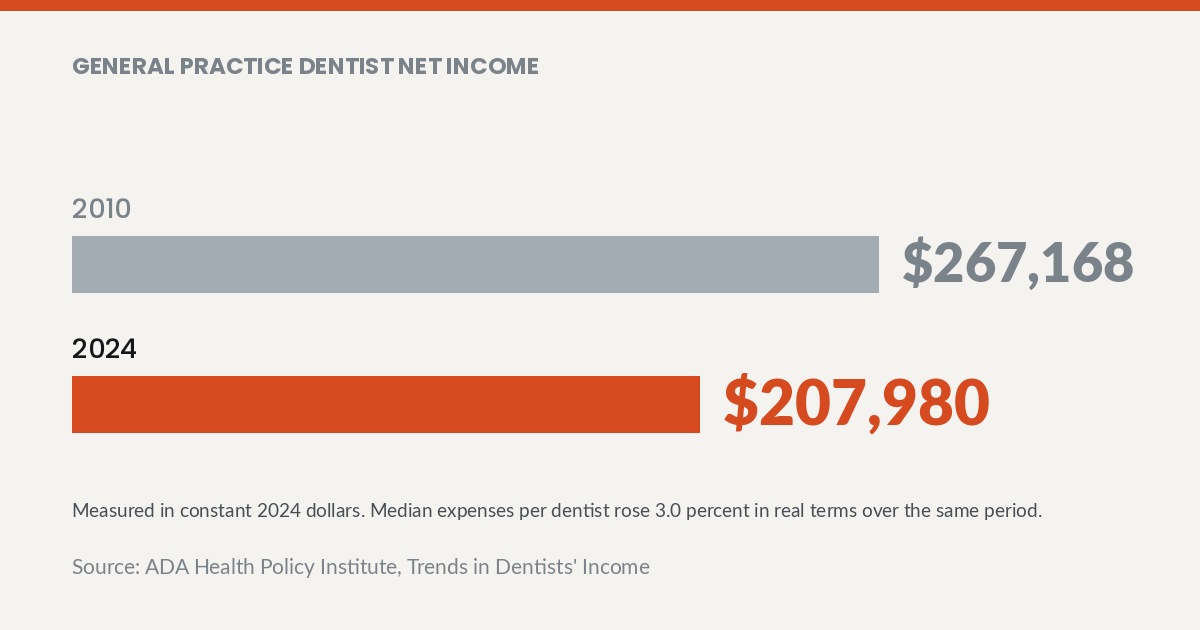
A dental practice management consultant should start with the income trend rather than the marketing plan. ADA Health Policy Institute data shows general practice dentist net income fell from $267,168 in 2010 to $207,980 in 2024, measured in constant 2024 dollars. Every ownership, staffing, and consolidation question in dentistry follows from that decline.
One Number Explains the Decade
Dentistry is usually discussed as a growth market with a marketing problem. New patient acquisition, case acceptance, and online reviews dominate the consulting conversation. The income data describes a profession that has been getting poorer in real terms for well over a decade.
The ADA Health Policy Institute tracks net income for general practice dentists in constant dollars, which removes inflation from the comparison. Measured that way, the figure fell from $267,168 in 2010 to $207,980 in 2024. A dentist practicing across that entire span earned less at the end than at the beginning.
That is not a soft trend or the result of a single bad year. It is a sustained decline in the economic return of owning and running a dental practice. Strategies built on the assumption of a healthy underlying market are solving for conditions that stopped existing.
Average net income for all general practice dentists now sits at $215,320 with a median of $185,010, according to ADA HPI Survey of Dental Practice data for 2025. The gap between average and median indicates a distribution pulled upward by stronger performers. Half the profession earns below the median figure, which changes how national averages should be read.
Expenses Moved the Other Way
ADA HPI reports median expenses per dentist rising from $468,459 across 2015 to 2019 to $482,343 across 2020 to 2024. That represents a 3.0 percent real increase, meaning after inflation. Income fell while the cost of producing that income rose.
Overhead is the operating variable most practices claim to manage and least often measure precisely. Staffing costs, supply costs, and equipment service contracts all moved during that window. Practices that never rebuilt their fee schedule against those changes absorbed the difference in owner compensation.
Gross billings per general practice owner dentist average $965,660, with a median of $893,510, according to ADA HPI Survey of Dental Practice Table 5 for 2025. Set that against average owner net income of $228,980 and the scale of the overhead problem becomes visible. Production is not the constraint in most struggling practices.
Collections Versus Production
The gap between what a practice produces and what it collects is where a large share of that overhead disappears. Adjustments, write-offs, and payer contract terms erode the difference before anyone reviews it. Practices tracking production alone are reporting on work performed rather than money received.
Payer mix drives most of this erosion quietly and without any triggering event. A reimbursement rate accepted years ago compounds against rising expenses without a single decision being made. Reviewing the fee schedule and payer participation annually is basic operating hygiene that many practices skip.
The review itself is not complicated and it is rarely comfortable. It requires ranking plans by net collection per procedure and being willing to drop the worst performers. Practices that refuse to run that analysis are accepting whatever terms accumulated over the previous decade.
Ownership Is Not Declining at Random
Practice ownership among dentists stands at 73 percent, down from 85 percent in 2005 according to ADA HPI. That is a substantial structural shift to occur inside a single professional generation. It tracks the income data closely enough that the two should be read together.
DSO affiliation reached 16.1 percent of all dentists in the ADA HPI figures for 2024, more than double the 7.2 percent recorded in 2015. Among dentists fewer than five years out of school, 31 percent are DSO affiliated. That figure approaches 50 percent in Nevada, Arizona, Colorado and Oklahoma.
Early-career dentists are making a rational calculation with the information available. Practice acquisition requires debt on top of education debt, and the income data no longer supports the premium that ownership once carried. A salaried position with predictable hours competes well against that proposition.
The state-level concentration is the detail most owners overlook. Where DSO affiliation approaches half of early-career dentists, the associate hiring market has already been reset by an employer with different economics. An independent practice in those states is not competing on compensation alone.
Employed and associate general practitioners average $164,510 according to ADA HPI Survey of Dental Practice data for 2025. Owner dentists average $228,980 with a median of $199,140. The ownership premium exists, and it now has to be weighed against practice debt, management burden, and the direction of the income trend.
What This Means for Practice Transition
Practice valuation assumptions built during a stronger income environment are still circulating. Sellers expect multiples that the current earnings picture does not support from an individual buyer. DSO buyers can pay more because they consolidate overhead across locations, which an individual buyer cannot do.
That dynamic reshapes retirement planning for owner dentists approaching transition. A partnership track for an associate remains viable, and it requires the associate to see a credible path to income that beats the salaried alternative. Practices that cannot demonstrate that path lose associates to DSO recruiting.
What the Survey Data Does Not Tell You
The ADA Survey of Dental Practice carries a 1.9 percent response rate, drawn from 1,113 responses out of a sample of 59,951. That is a thin base for national estimates. Anyone using these figures for planning should hold them as directional rather than precise.
Low response rates introduce the possibility that responding dentists differ systematically from non-responders. The direction of the income trend is corroborated by the ownership and DSO affiliation shifts, which come from different measurement approaches. The specific dollar figures deserve more caution than the pattern they describe.
US Census County Business Patterns for 2023 counts 135,665 dental establishments employing 1,028,889 people. That is a census rather than a survey, and it establishes the scale of the sector independent of response rate concerns. A practice benchmarking against national averages should know which kind of number it is using.
What a Practice Owner Should Actually Do
The correct response to a long real-income decline is not more marketing spend. It is an operating review of every variable that sits between production and net income. Most practices have never conducted that review with any rigor.
Rebuild the Cost Structure First
Overhead categories should be measured as a percentage of collections and compared across periods, not against a national benchmark of uncertain provenance. Staffing, supplies, lab, facility, and administrative costs each behave differently. Practices that track them as a single blended overhead number cannot act on any of them.
The hygiene department deserves separate analysis because it operates on different economics than restorative production. A hygiene program that runs at or below break-even is a common and correctable finding. Operatory use and scheduling design usually explain more of the result than hygienist compensation.
Supply and lab costs behave differently again and respond to different interventions. Supply spend responds to ordering discipline and vendor consolidation, which are administrative fixes. Lab spend responds to case mix and material selection, which are clinical decisions with financial consequences that rarely get reviewed together.
Fix the Associate Equation
Associate compensation structures written a decade ago no longer reflect the market that DSO affiliation created. An associate weighing a salaried role against a production-based arrangement is comparing risk as much as dollars. Owners who cannot articulate the ownership path in specific terms will keep losing that comparison.
Owners rebuilding compensation models, overhead reporting, and transition planning at the same time are running a business restructuring rather than a dental problem. That work has more in common with operational management consulting than with practice marketing, and it should be staffed accordingly.
Decide About Consolidation Deliberately
DSO affiliation is a legitimate strategic option rather than a failure state. The affiliation figures show where the profession is heading, and the early-career numbers show how fast. An owner who evaluates affiliation on operating terms will negotiate better than one who arrives at it under pressure.
The alternative path is real and requires deliberate construction. Independent practices that control overhead, manage payer mix actively, and build genuine partnership tracks continue to produce strong owner income. That outcome does not happen by default and it never happens through marketing alone.
Timing matters more in that decision than most owners assume. Affiliation terms depend heavily on demonstrated operating performance, which takes years to build and cannot be assembled in the months before a sale. Owners who improve overhead and payer mix first negotiate from evidence rather than from projections.
The profession has spent fifteen years explaining declining practice economics as a marketing shortfall, a scheduling problem, or a case acceptance issue. The ADA data points toward a less comfortable explanation than any of those. Real income has fallen while real expenses have risen, and ownership rates and DSO affiliation have moved exactly as that pressure would predict. A practice owner who reads those numbers honestly stops looking for a growth tactic and starts examining the structure of the business itself. That examination is the actual work, and it is the part nobody sells as a seminar.
Frequently Asked Questions
Has dentist income really fallen since 2010?
ADA Health Policy Institute data measured in constant 2024 dollars shows general practice dentist net income falling from $267,168 in 2010 to $207,980 in 2024. Constant dollars remove inflation, so the comparison reflects real purchasing power rather than nominal amounts. Nominal income figures over the same period look considerably better and mislead anyone planning against them. The real trend is what determines whether ownership remains economically attractive.
Why are so many young dentists joining DSOs?
ADA HPI data for 2024 shows 31 percent of dentists fewer than five years out of school are DSO affiliated, approaching 50 percent in Nevada, Arizona, Colorado and Oklahoma. Practice acquisition requires substantial debt layered on top of education debt. With average employed and associate general practitioner income at $164,510 and owner income at $228,980, the ownership premium exists but carries real risk. Early-career dentists are weighing that trade-off and choosing predictability.
How reliable are the ADA income figures?
The ADA Survey of Dental Practice reports a 1.9 percent response rate, based on 1,113 responses from a sample of 59,951. That is a thin base and warrants caution with specific dollar amounts. The overall direction is supported by independent measures, including the ownership decline from 85 percent in 2005 to 73 percent and the rise in DSO affiliation. Practices should treat the figures as directional evidence rather than precise benchmarks.
Should my practice cut overhead or increase production?
The ADA HPI figures show gross billings per general practice owner dentist averaging $965,660 against average owner net income of $228,980. That spread indicates that cost structure, not production volume, drives most net income variation. Median expenses per dentist rose 3.0 percent in real terms between the 2015 to 2019 period and the 2020 to 2024 period. Practices generally find more recoverable income in overhead review and payer mix than in additional production.
What should a practice valuation look like now?
Valuation expectations formed during a stronger income environment persist among sellers and no longer match what individual buyers can finance. DSO buyers can pay more because they spread overhead across multiple locations, which changes the comparison. Owners planning a transition should model both buyer types separately rather than assuming a single market price. Building a credible partnership track for an existing associate preserves a third option.
Does a dental practice management consultant help with marketing or operations?
The income data indicates that operations deserve attention before marketing in most practices. Real net income has declined while real expenses have risen, which is a cost structure and payer mix problem rather than a demand problem. Practices that add patient volume without repairing overhead often increase production and stress without improving owner income. The order of operations matters more than the choice of tactics.
No comments:
Post a Comment
Note: Only a member of this blog may post a comment.