Showing posts with label Finance. Show all posts

Tuesday, July 28, 2026

The Costs That Only Become Visible After They Have Been Paid

Costs surface after they are paid. Risk announces itself late, when the options are worst.

Business risk management is the practice of measuring exposure before an incident rather than after one. Most costs in a small business become visible only after they have been paid, when the options remaining are the worst available. The discipline is early measurement rather than prediction. Putting a number on an exposure while it is still small is the entire job.

Why Bad News Arrives Late

Small businesses rarely fail from a single dramatic event. They fail from a slow drift that nobody measured, because nothing ever looked urgent enough to measure. Revenue holds, the calendar stays full, and the margin thins quietly underneath both. By the time the erosion registers in the bank balance, several years of decisions have already compounded.

The mechanism behind the delay is straightforward enough to describe. Prices move slowly, costs move slowly, and the gap between them changes far too gradually to trigger any alarm. Owners compare this year with last year and reasonably conclude that conditions are stable. The comparison that would reveal the problem sits between what the work earns now and what it earned a decade ago.

Professional practices show the pattern clearly because their revenue looks steady throughout. Examining how practitioner earnings can fall in real terms while headline revenue holds steady makes the drift visible in a way annual comparison never manages. The same arithmetic applies to any business selling skilled time at a slowly adjusting price.

Measurement before the incident is the only defence against this class of problem. A business that reviews its unit economics against a long baseline notices erosion while correction remains cheap. A business that reviews against last year alone notices nothing until a lender asks a question.

The review itself does not need to be elaborate to work. Tracking what a standard unit of work earns, what it costs to deliver, and how both have moved across several years is enough. Owners who keep that one series honest catch most slow problems early.

Frequency is the other half of the defence. A figure reviewed once a year produces too few observations to reveal a trend in time. A quarterly series makes the direction obvious long before the level becomes alarming.

Cutting Cost Before the Pressure Arrives

Cost reduction under pressure is almost always worse than cost reduction by choice. Panic cutting removes whatever is easiest to remove, which is usually marketing, training and maintenance. Those three protect future revenue, so the cut improves this quarter and damages the next several. The business then repeats the exercise from a weaker position each time.

Deliberate cost work asks a different question from the panic version. Rather than asking what can be removed, it asks what each line actually buys and whether that purchase still makes sense. Approaching spending decisions during a downturn as a selection problem rather than a subtraction problem preserves the capacity that any recovery will require.

Sequencing matters more than the total amount removed. Cuts made early can be small, targeted and reversible if conditions improve. Cuts made late must be large, blunt and permanent, because the cash position no longer allows judgment. Owners who model a downturn before it arrives keep the ability to choose.

Financial capability is what makes early action possible at all. Most small businesses have bookkeeping and no financial leadership, which means they hold a record of the past and no view forward. Adding senior financial judgment without carrying a full-time executive salary converts historical accounts into forward scenarios.

Forecasting, covenant awareness and runway analysis require a level of skill that bookkeeping does not include. The gap shows up first in conversations with lenders, who ask questions about the future rather than the past. A business that cannot answer those questions borrows on worse terms or fails to borrow at all.

Reversibility deserves more weight than it normally receives in these decisions. A contract that can be paused costs slightly more than one that cannot, and it buys room to manoeuvre. Owners under pressure often discover that most of their commitments were written without any such flexibility.

Shocks That Originate Outside the Business

Some exposures cannot be prevented by any internal decision. Trade policy, currency movement, supplier failure and regulatory change all arrive from outside and land on the cost base without notice. The controllable variable is not the shock itself. What can be controlled is how quickly the business sees it and responds.

Import-dependent firms have learned this recently and expensively. Understanding how trade policy shifts reach a small business through its supply chain and pricing is now part of ordinary planning rather than an economics discussion. A sourcing decision made years earlier usually determines how badly the change lands.

Preparation for external shocks is mostly structural rather than analytical. Concentration is the underlying risk in nearly every case, whether it sits in one supplier, one customer, one country or one product line. Businesses that map their concentrations in advance know immediately where to look when something moves.

Businesses that have not mapped them spend the first critical weeks working out what is exposed. Those weeks are exactly when suppliers are being renegotiated and customers are deciding where to place volume. Speed of response, rather than accuracy of forecast, separates the outcomes.

The map itself is a short document that fits comfortably on one page. Listing the largest supplier, the largest customer, the dominant currency and the dominant product line takes very little time. Reviewing that page each quarter is a reasonable definition of preparedness for a small business.

Diversification carries a cost that owners should price honestly rather than avoid. A second supplier is usually more expensive than the first and rarely receives the same volume. That premium is insurance, and it belongs alongside the cost of a week with no supply at all.

Compliance Failures Are Slow and Then Sudden

Compliance risk behaves quite differently from financial or operational risk. It accumulates invisibly over a long period and then converts into a single expensive event without warning. Nothing about the intervening quiet indicates that the business is actually safe. It indicates only that nobody has looked yet.

The controls involved are unglamorous and cheap relative to the exposure they remove. Documented procedures, defined approval limits and periodic review cost a modest amount of management attention. Treating ethical and regulatory compliance as an operating control rather than a legal formality puts those checks where the work actually happens.

Culture determines whether the controls function or merely exist on paper. Staff who believe that reporting a problem will be treated as disloyalty will stop reporting problems entirely. The business then holds a framework that produces clean paperwork and no information at all. Owners should ask when anyone last raised something genuinely uncomfortable.

The failure mode is worth stating precisely because it is easy to miss. A compliance system that has never surfaced bad news is probably not working. It is far more likely to be unused than unnecessary. Any control that has never fired deserves a test rather than confidence.

Smaller scale does not exempt a business from any of this. Small firms face many of the same regulatory obligations as larger ones with a fraction of the specialist support. The practical answer is a small number of documented controls that a manager can genuinely run each month.

Documentation also protects the business when a key person leaves. Controls that live only in one manager's memory disappear on the day that manager resigns. Writing them down converts personal knowledge into something the business actually owns.

Obligations That Become Costs Later

A growing share of small business risk arrives through relationships rather than regulation. Larger customers, lenders and insurers increasingly ask about environmental practice, labour conditions and supply chain provenance. A business unable to answer those questions loses contracts rather than paying fines. The cost stays invisible because it appears as an opportunity that never materialised.

Change programmes are where these obligations either become operational or quietly disappear. Linking change initiatives to environmental and governance commitments so the change survives prevents the familiar pattern where a policy is announced and never reaches daily work. A commitment without an operating change behind it is a liability with a publication date.

The broader position is worth stating plainly for owners who see this as overhead. Social and environmental obligation has moved from a reputational option to a commercial requirement across many supply chains. Treating social responsibility as a source of durable commercial advantage rather than an expense reframes the spending as market access.

Small firms hold an advantage here that larger ones do not. A short supply chain and direct relationships make it far easier to describe actual practice accurately. The difficulty is usually evidence rather than behaviour, and evidence is a documentation problem.

Businesses that treat it purely as cost will discover the real price at contract renewal. Procurement teams now score suppliers against criteria that did not exist when the relationship began. Answering those questions well takes preparation that cannot be assembled in the week a tender is due.

Every category described here shares the same underlying structure. The information needed to act cheaply exists well before the moment of crisis, and it goes unexamined because nothing is on fire. Risk management in a small business is therefore mostly a scheduling problem rather than an analytical one. Owners who book the review while conditions are calm keep the ability to choose, which is the only asset a difficult year genuinely removes.

Frequently Asked Questions

What does business risk management actually mean for a small business?
It means identifying the exposures that could materially damage the business and measuring them before they trigger. That list includes margin erosion, customer concentration, supplier dependence, cash timing and compliance gaps. The output is a short set of exposures with a number attached and an owner assigned. Elaborate frameworks usually reduce the chance that the review actually happens.

How often should a small business review its risks?
A structured review once a quarter is sufficient for most small businesses. That review should cover concentration, cash runway, margin trend and any open compliance items. Anything that changes the cost base materially should trigger an additional review outside the normal cycle. Cadence matters more than depth, because an unreviewed register is the same as no register.

Which costs are usually invisible until it is too late?
Slow margin erosion is the most common, because revenue can look healthy while profitability declines. Deferred maintenance and deferred training behave the same way, appearing as savings and arriving later as failures. Customer concentration stays invisible until the largest account decides to leave. Each of these can be measured cheaply in advance and rarely is.

Is a fractional finance executive worth it at small scale?
It becomes worthwhile once decisions depend on forward numbers rather than historical records. Bookkeeping describes what already happened, which is a different capability from forecasting and scenario planning. Part-time senior finance gives a small business that analysis without a full executive salary. The value tends to show up first in cash planning and lender conversations.

How should external shocks such as trade policy changes be handled?
The shock itself cannot be controlled, so preparation focuses on visibility and flexibility instead. Businesses should map where they are concentrated across suppliers, customers, currencies and product lines. That map turns a general worry into a specific list of exposures that can be hedged or diversified. Response speed matters more than forecasting accuracy in almost every case.

Is compliance a risk to manage or simply a cost to accept?
It functions as a risk because the exposure builds silently and converts into a single large event. The controls that prevent it are inexpensive compared with the consequence of a failure. Documented procedures, approval limits and periodic review handle most of the exposure in a small business. Culture decides whether those controls produce real information or only paperwork.

Tuesday, March 3, 2026

Dentist Income Is Lower in Real Terms Now Than It Was in 2010

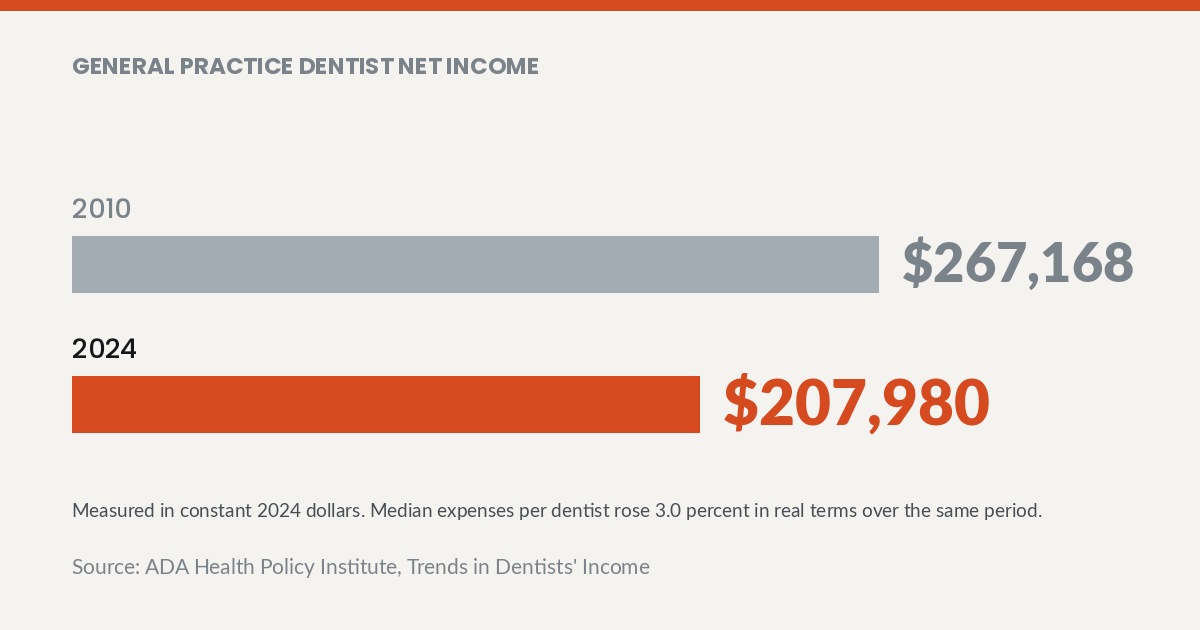
General practice dentist net income: 2010 $267,168, 2024 $207,980. ADA Health Policy Institute, Trends in Dentists' Income

A dental practice management consultant should start with the income trend rather than the marketing plan. ADA Health Policy Institute data shows general practice dentist net income fell from $267,168 in 2010 to $207,980 in 2024, measured in constant 2024 dollars. Every ownership, staffing, and consolidation question in dentistry follows from that decline.

One Number Explains the Decade

Dentistry is usually discussed as a growth market with a marketing problem. New patient acquisition, case acceptance, and online reviews dominate the consulting conversation. The income data describes a profession that has been getting poorer in real terms for well over a decade.

The ADA Health Policy Institute tracks net income for general practice dentists in constant dollars, which removes inflation from the comparison. Measured that way, the figure fell from $267,168 in 2010 to $207,980 in 2024. A dentist practicing across that entire span earned less at the end than at the beginning.

That is not a soft trend or the result of a single bad year. It is a sustained decline in the economic return of owning and running a dental practice. Strategies built on the assumption of a healthy underlying market are solving for conditions that stopped existing.

Average net income for all general practice dentists now sits at $215,320 with a median of $185,010, according to ADA HPI Survey of Dental Practice data for 2025. The gap between average and median indicates a distribution pulled upward by stronger performers. Half the profession earns below the median figure, which changes how national averages should be read.

Expenses Moved the Other Way

ADA HPI reports median expenses per dentist rising from $468,459 across 2015 to 2019 to $482,343 across 2020 to 2024. That represents a 3.0 percent real increase, meaning after inflation. Income fell while the cost of producing that income rose.

Overhead is the operating variable most practices claim to manage and least often measure precisely. Staffing costs, supply costs, and equipment service contracts all moved during that window. Practices that never rebuilt their fee schedule against those changes absorbed the difference in owner compensation.

Gross billings per general practice owner dentist average $965,660, with a median of $893,510, according to ADA HPI Survey of Dental Practice Table 5 for 2025. Set that against average owner net income of $228,980 and the scale of the overhead problem becomes visible. Production is not the constraint in most struggling practices.

Collections Versus Production

The gap between what a practice produces and what it collects is where a large share of that overhead disappears. Adjustments, write-offs, and payer contract terms erode the difference before anyone reviews it. Practices tracking production alone are reporting on work performed rather than money received.

Payer mix drives most of this erosion quietly and without any triggering event. A reimbursement rate accepted years ago compounds against rising expenses without a single decision being made. Reviewing the fee schedule and payer participation annually is basic operating hygiene that many practices skip.

The review itself is not complicated and it is rarely comfortable. It requires ranking plans by net collection per procedure and being willing to drop the worst performers. Practices that refuse to run that analysis are accepting whatever terms accumulated over the previous decade.

Ownership Is Not Declining at Random

Practice ownership among dentists stands at 73 percent, down from 85 percent in 2005 according to ADA HPI. That is a substantial structural shift to occur inside a single professional generation. It tracks the income data closely enough that the two should be read together.

DSO affiliation reached 16.1 percent of all dentists in the ADA HPI figures for 2024, more than double the 7.2 percent recorded in 2015. Among dentists fewer than five years out of school, 31 percent are DSO affiliated. That figure approaches 50 percent in Nevada, Arizona, Colorado and Oklahoma.

Early-career dentists are making a rational calculation with the information available. Practice acquisition requires debt on top of education debt, and the income data no longer supports the premium that ownership once carried. A salaried position with predictable hours competes well against that proposition.

The state-level concentration is the detail most owners overlook. Where DSO affiliation approaches half of early-career dentists, the associate hiring market has already been reset by an employer with different economics. An independent practice in those states is not competing on compensation alone.

Employed and associate general practitioners average $164,510 according to ADA HPI Survey of Dental Practice data for 2025. Owner dentists average $228,980 with a median of $199,140. The ownership premium exists, and it now has to be weighed against practice debt, management burden, and the direction of the income trend.

What This Means for Practice Transition

Practice valuation assumptions built during a stronger income environment are still circulating. Sellers expect multiples that the current earnings picture does not support from an individual buyer. DSO buyers can pay more because they consolidate overhead across locations, which an individual buyer cannot do.

That dynamic reshapes retirement planning for owner dentists approaching transition. A partnership track for an associate remains viable, and it requires the associate to see a credible path to income that beats the salaried alternative. Practices that cannot demonstrate that path lose associates to DSO recruiting.

What the Survey Data Does Not Tell You

The ADA Survey of Dental Practice carries a 1.9 percent response rate, drawn from 1,113 responses out of a sample of 59,951. That is a thin base for national estimates. Anyone using these figures for planning should hold them as directional rather than precise.

Low response rates introduce the possibility that responding dentists differ systematically from non-responders. The direction of the income trend is corroborated by the ownership and DSO affiliation shifts, which come from different measurement approaches. The specific dollar figures deserve more caution than the pattern they describe.

US Census County Business Patterns for 2023 counts 135,665 dental establishments employing 1,028,889 people. That is a census rather than a survey, and it establishes the scale of the sector independent of response rate concerns. A practice benchmarking against national averages should know which kind of number it is using.

What a Practice Owner Should Actually Do

The correct response to a long real-income decline is not more marketing spend. It is an operating review of every variable that sits between production and net income. Most practices have never conducted that review with any rigor.

Rebuild the Cost Structure First

Overhead categories should be measured as a percentage of collections and compared across periods, not against a national benchmark of uncertain provenance. Staffing, supplies, lab, facility, and administrative costs each behave differently. Practices that track them as a single blended overhead number cannot act on any of them.

The hygiene department deserves separate analysis because it operates on different economics than restorative production. A hygiene program that runs at or below break-even is a common and correctable finding. Operatory use and scheduling design usually explain more of the result than hygienist compensation.

Supply and lab costs behave differently again and respond to different interventions. Supply spend responds to ordering discipline and vendor consolidation, which are administrative fixes. Lab spend responds to case mix and material selection, which are clinical decisions with financial consequences that rarely get reviewed together.

Fix the Associate Equation

Associate compensation structures written a decade ago no longer reflect the market that DSO affiliation created. An associate weighing a salaried role against a production-based arrangement is comparing risk as much as dollars. Owners who cannot articulate the ownership path in specific terms will keep losing that comparison.

Owners rebuilding compensation models, overhead reporting, and transition planning at the same time are running a business restructuring rather than a dental problem. That work has more in common with operational management consulting than with practice marketing, and it should be staffed accordingly.

Decide About Consolidation Deliberately

DSO affiliation is a legitimate strategic option rather than a failure state. The affiliation figures show where the profession is heading, and the early-career numbers show how fast. An owner who evaluates affiliation on operating terms will negotiate better than one who arrives at it under pressure.

The alternative path is real and requires deliberate construction. Independent practices that control overhead, manage payer mix actively, and build genuine partnership tracks continue to produce strong owner income. That outcome does not happen by default and it never happens through marketing alone.

Timing matters more in that decision than most owners assume. Affiliation terms depend heavily on demonstrated operating performance, which takes years to build and cannot be assembled in the months before a sale. Owners who improve overhead and payer mix first negotiate from evidence rather than from projections.

The profession has spent fifteen years explaining declining practice economics as a marketing shortfall, a scheduling problem, or a case acceptance issue. The ADA data points toward a less comfortable explanation than any of those. Real income has fallen while real expenses have risen, and ownership rates and DSO affiliation have moved exactly as that pressure would predict. A practice owner who reads those numbers honestly stops looking for a growth tactic and starts examining the structure of the business itself. That examination is the actual work, and it is the part nobody sells as a seminar.

Frequently Asked Questions

Has dentist income really fallen since 2010?
ADA Health Policy Institute data measured in constant 2024 dollars shows general practice dentist net income falling from $267,168 in 2010 to $207,980 in 2024. Constant dollars remove inflation, so the comparison reflects real purchasing power rather than nominal amounts. Nominal income figures over the same period look considerably better and mislead anyone planning against them. The real trend is what determines whether ownership remains economically attractive.

Why are so many young dentists joining DSOs?
ADA HPI data for 2024 shows 31 percent of dentists fewer than five years out of school are DSO affiliated, approaching 50 percent in Nevada, Arizona, Colorado and Oklahoma. Practice acquisition requires substantial debt layered on top of education debt. With average employed and associate general practitioner income at $164,510 and owner income at $228,980, the ownership premium exists but carries real risk. Early-career dentists are weighing that trade-off and choosing predictability.

How reliable are the ADA income figures?
The ADA Survey of Dental Practice reports a 1.9 percent response rate, based on 1,113 responses from a sample of 59,951. That is a thin base and warrants caution with specific dollar amounts. The overall direction is supported by independent measures, including the ownership decline from 85 percent in 2005 to 73 percent and the rise in DSO affiliation. Practices should treat the figures as directional evidence rather than precise benchmarks.

Should my practice cut overhead or increase production?
The ADA HPI figures show gross billings per general practice owner dentist averaging $965,660 against average owner net income of $228,980. That spread indicates that cost structure, not production volume, drives most net income variation. Median expenses per dentist rose 3.0 percent in real terms between the 2015 to 2019 period and the 2020 to 2024 period. Practices generally find more recoverable income in overhead review and payer mix than in additional production.

What should a practice valuation look like now?
Valuation expectations formed during a stronger income environment persist among sellers and no longer match what individual buyers can finance. DSO buyers can pay more because they spread overhead across multiple locations, which changes the comparison. Owners planning a transition should model both buyer types separately rather than assuming a single market price. Building a credible partnership track for an existing associate preserves a third option.

Does a dental practice management consultant help with marketing or operations?
The income data indicates that operations deserve attention before marketing in most practices. Real net income has declined while real expenses have risen, which is a cost structure and payer mix problem rather than a demand problem. Practices that add patient volume without repairing overhead often increase production and stress without improving owner income. The order of operations matters more than the choice of tactics.

Wednesday, October 22, 2025

How We Slashed Vendor Costs by 32% Using Executive Consulting—A Step-By-Step Guide for SMB Owners


For small businesses, vendor expenses typically account for a major portion of operating costs. Hidden fees, legacy contracts, and lack of continuous review can quietly chip away at your margins. But executive consulting is not just for big companies. It is how thousands of SMBs reclaim lost profits, create negotiating use, and streamline operations in ways that are not possible alone. In this post, follow every step the team used to help a real SMB reduce vendor costs by 32% in just one quarter. You will get actionable tactics, expert insights, frequently asked questions, and ongoing strategies from seasoned consultants at Kamyar Shah and industry leaders at World Consulting Group.

Why Vendor Costs Are a Persistent Problem for SMBs

Whether you operate a tech startup or a family-owned shop, vendor costs have a way of steadily rising. Here are some reasons why:

  • Legacy contracts: Old agreements are rarely renegotiated and often auto-renew at increased rates.
  • Poor visibility: With no central record, businesses lose sight of what they are actually paying for.
  • Multiple owners: Different employees managing separate subscriptions and purchases causes overlap and waste.
  • Vendor complacency: Long-term vendors may stop offering competitive rates unless challenged.
  • No benchmarking: Many SMBs do not know their options, market norms, or best-in-class rates for services.

The result? Hundreds, sometimes thousands, in “invisible” spend. Consulting professionals identify these areas with objective audits and deliver proven results.

Step 1: Complete Vendor Cost Audit and Assessment

The first step a consultant initiates is a full vendor audit. Here is the process:

  • Create a master database of all active contracts, recurring payments, and vendor relationships.

Use free resources like Kamyar Shah’s operations management checklist to speed up the process. Consultants often uncover 10 to 20% “phantom” costs simply by centralizing information.

Step 2: Benchmarking and Market Comparison

A key benefit of working with executive consultants is market knowledge. Here is how benchmarking works:

  • For each major vendor, request updated quotes, product catalogs, and service options.
  • Gather competitive offers from at least three alternate providers for essential services.
  • Use consulting firm templates to automate the outreach and information-gathering process.
  • Identify best-in-class pricing, service terms, and support provisions for each vendor category.
  • Consultant teams at organizations like World Consulting Group provide plug-and-play comparison charts and negotiation scripts.

In one tech SMB case, digital marketing and hosting costs dropped 18% after just two rounds of competitive benchmarking and negotiation, using a consultant-designed template.

Step 3: Eliminate Overlaps, Redundancies, and Inefficiencies

Most SMBs discover they pay for duplicate tools. For example:

  • Two project management platforms with different teams (can be consolidated).
  • Multiple digital communication tools covered under larger software suites (cancel the extras).
  • Legacy licenses that nobody has used for over a year.

Executive consultants drive coordinated consolidation:

  • Appoint a single vendor management owner to oversee contract renewals, approvals, and consolidation.
  • Centralize the purchasing process with IT or an office manager to avoid overlap.
  • Cancel unused subscriptions quickly and gracefully, using consultant-provided termination notice scripts.

In a healthcare client engagement, Kamyar Shah’s process saved $11,000 annually by consolidating software licenses and removing unused employee accounts, see more in real client testimonials.

Step 4: Renegotiate Terms and Drive Down Costs

Consultants bring professional negotiation tactics that obtain big savings:

  • Push for bundled service rates and bulk discounts when you use multiple offerings from a single vendor.
  • Renegotiate contracts to increase payment terms (e.g., moving from Net 15 to Net 45).
  • Add performance-based clauses (such as price guarantees or service level minimums) to protect your interests.
  • Request free upgrades, onboarding support, or feature packages during renewal talks.
  • Work with experienced teams like World Consulting Group who can use existing market relationships for better deals.

A logistics SMB improved cash flow by negotiating longer payment terms and gained $17,000 in savings after consultant-led renegotiation and supplier restructuring.

Step 5: Build an Ongoing Vendor Optimization Program

A one-time review is not enough. High-performing SMBs make cost management routine:

  • Schedule vendor reviews every six months.
  • Institute cross-functional feedback so teams can rate vendor performance and recommend improvements.
  • Create a digital dashboard using a template from Kamyar Shah to track costs and contract deadlines.
  • Develop policies that require all new contracts to be reviewed by a consulting-trained owner.
  • Adopt a “never auto-renew” approach: every contract is checked before money leaves the account.

Consultants provide added value by training internal teams to sustain savings long after the engagement ends.

Real Data: Before and After Consulting Engagement

MetricBefore ConsultingAfter (90 Days)
Total vendor spend/mo$55,000$37,400
Contracts auto-renewed144
SaaS/license waste23%6%
Number of vendors3821
Average payment termsNet 15Net 45

All numbers sourced from anonymized SMB case data via Kamyar Shah and World Consulting Group.

Detailed Case Study Highlight

Consider a detailed success story:

  • Business Type: Logistics SMB, 23 employees
  • Challenge: 41 separate vendor relationships, high monthly spend, tight cash flow
  • Phase 1: Consultant performed a rapid audit and found $18,000 in duplicative contracts alone.
  • Phase 2: Contacts were consolidated, overlapping services removed, and core agreements renegotiated for better rates and payment terms.
  • Phase 3: The owner was trained using Kamyar Shah’s cost management playbook.
  • Result: Within 90 days, net monthly vendor spend fell from $55K to under $38K, with improved cash flow and team morale.
  • Ongoing: With biannual reviews, sustained savings continue to grow for the business.

How to Start with Executive Consulting

Ready to save money and gain control? Here is your checklist:

  1. Research consulting partners with verified results and sector focus. Begin with profiles at Kamyar Shah and World Consulting Group.
  2. Request a vendor cost audit and establish up-front benchmarks for success.
  3. Ask for a clear, actionable engagement roadmap. No vague advice, only measurable results.
  4. Review consultant guarantees, satisfaction policies, and service tiers (see World Consulting Group’s policies).
  5. Get full transparency on fees, projected ROI, and reporting processes.

Frequently Asked Questions

  • Can small businesses afford consulting?
    Yes! Most consulting engagements yield savings that exceed fees several times over, and fractional/project-based models allow flexibility. See more on cost-effective solutions at Kamyar Shah.
  • How long does vendor optimization take?
    First results normally appear within weeks, with full transformation and savings measured at 90 days and beyond, cemented by ongoing reviews.
  • What about complex contracts?
    Top consultants help parse legal agreements, identify negotiating use, and provide contract review services for nonprofits and government sector organizations at cost. For further support, see World Consulting Group’s packages.
  • Does vendor optimization impact vendor relationships?
    No. Consultants are trained negotiators who maintain relationships while ensuring terms are fair and competitive. They often strengthen partnerships through transparency and ongoing review.
  • Can this work for SaaS-heavy businesses?
    Absolutely. SaaS and license waste reduction is a major area for savings. Kamyar Shah’s process routinely finds 25%+ savings in SaaS-heavy environments.

Conclusion

Vendor optimization is a proven path to profitability for every growing SMB. By partnering with executive consultants, you gain not just expertise and negotiating power. But ongoing systems for cost control and sustainable savings. If vendor costs are squeezing your margins, do not wait. Begin with a complete audit, establish benchmarks, eliminate waste, negotiate favorable new terms, and establish a routine for ongoing optimization.

For more actionable resources and direct support, contact:
Kamyar Shah Consulting
World Consulting Group


Monday, October 20, 2025

SMB Expenditures During Economic Downturn: A Strategic Guide to Intelligent Cost Management


The Economic Reality Facing SMBs Today

Economic downturns are inevitable cycles that test the resilience of small-to-medium businesses (SMBs) worldwide. Current data reveals the challenging landscape SMBs navigate: 88% of U.S. small businesses face regular cash flow disruptions, while 70% of small business owners expect a recession within the next six months. With inflation cited as the primary concern for 48% of SMB respondents and 6 in 10 small business owners reporting negative impacts from inflation and rising costs, the pressure on expenditure management has never been greater. news.nationwide+2

The stark reality is that approximately 24.2% of private sector businesses fail within their first year, with 48.5% failing within five years. However, those businesses that survive initial challenges demonstrate remarkable resilience, 67.9% of new employer establishments survive their first two years, and among establishments that survive their first five years, 69.5% continue operating for at least ten yearslendio+1

The Strategic Imperative: Beyond Reactive Cost-Cutting

The fundamental challenge facing SMB leaders during economic uncertainty is distinguishing between strategic cost management and destructive austerity. Research from the New York Federal Reserve Bank reveals that small businesses experienced a 10.4% job decline during the recent recession, compared to 7.5% for larger firms, primarily due to poor sales, economic uncertainty, and weak consumer demandnewyorkfed

However, the most successful SMBs approach downturns differently. Rather than implementing blanket cuts, they focus on ROI-centric spending frameworks that preserve competitive positioning while optimizing operational efficiency. This strategic approach recognizes that not all expenditures are equal. Some represent consumptive costs that drain resources, while others function as productive investments that generate measurable returns.

The Marketing Investment Paradox: Data-Driven Evidence

One of the most counterintuitive yet well-documented strategies involves maintaining marketing investments during economic downturns. 28% of SMB owners identify cutting marketing or advertising as their first recession action. Higher than any other cost-cutting measure. This represents a critical strategic error supported by decades of research. emarketer

The landmark McGraw-Hill study analyzing 600 manufacturing firms during the 1981-82 recession provides compelling evidence: companies that maintained or increased advertising expenditures averaged 275% sales growth over five years, compared to only 19% growth for those that cut advertising. More recently, companies that kept advertising during recessions showed 256% higher sales growth compared to those that stopped, while businesses maintaining marketing spend experienced higher profits during recessions and sustained gains post-recessiontreefrogmarketing+3

This phenomenon extends beyond traditional advertising. Companies that increased marketing spend during recessions capture an average of five times the market share of competitors who reduce marketing efforts. The underlying principle is market dynamics: as competitors retreat from visibility, maintaining strategic marketing presence allows businesses to capture disproportionate attention at reduced cost-per-acquisition rates. prohed

Operational Restructuring: The 25% Efficiency Opportunity

From an operational management perspective, economic downturns create unique opportunities to identify and eliminate inefficiencies masked during growth periods. Nearly 6 in 10 (58%) business owners have explored areas to cut expenses within the last six months, but the most effective approach focuses on process optimization rather than arbitrary reductions.news.nationwide

Key operational restructuring strategies include:

Process Automation Implementation: AI-powered marketing systems provide SMB marketers the equivalent of 13 additional hours weekly while saving approximately $4,739 monthly per team. This represents significant labor cost reallocation without workforce reduction.forbes

Vendor Consolidation: Strategic vendor relationship management can reduce monthly operating expenses by 8-15% through consolidated services and improved payment terms negotiations.

Energy and Asset Optimization: Transitioning to hybrid operational models and optimizing physical space use enhances cash flow flexibility while reducing fixed overhead costs.

In practice, systematic workflow restructuring often yields up to 25% expense improvement without workforce reduction, preserving institutional knowledge while enhancing operational efficiency. nfib

Cash Flow Engineering: The 73% Preparedness Standard

Liquidity management represents the cornerstone of SMB survival during economic uncertainty. Current data shows that over 73% of small businesses maintain sufficient cash reserves to cover at least one month of operating expenses, yet this standard proves insufficient during extended downturns. The JPMorgan Chase Institute found that 50% of small businesses had fewer than fifteen cash buffer days, highlighting the critical importance of proactive cash flow engineering. ocrolus+1

Effective liquidity preservation strategies include:

Accelerated Receivables Management: Implementing incentive structures for early payment or using invoice factoring to improve working capital velocity.

Strategic Vendor Negotiations: Renegotiating payment terms and service agreements to preserve operational cash flow flexibility.

Just-in-Time Inventory Optimization: Adopting predictive ordering algorithms and streamlined inventory cycles to minimize capital allocation in non-productive assets.

These tactical approaches, combined with real-time accounting tools, enable SMBs to forecast cash burn rates under multiple scenarios and adjust capital allocation before liquidity exposure widens.

Human Capital Strategy: The Fractional Executive Advantage

Employee-related expenditures typically represent 50-70% of SMB operational costs, making workforce optimization critical during economic downturns. However, research consistently demonstrates that arbitrary payroll reductions rarely produce sustainable results. The superior approach involves restructuring workforce use to align with strategic outcomes while preserving core capabilities.

Fractional professional models represent a particularly effective strategy. Companies using fractional executives report 40-50% cost savings compared to full-time equivalents, with average annual management expense reductions of 40%. For example, fractional CTOs cost $3,000-$15,000 monthly compared to full-time CTOs averaging $486,874 annually, providing over $362,000 in annual savingstechneeds+1

Beyond cost considerations, companies using fractional tech leadership report 18% higher revenue growth and 15% greater profitability, demonstrating that strategic workforce optimization can simultaneously reduce costs and enhance performance outcomes. ctox

Data-Driven Decision Governance: The Rolling Forecast Model

Economic volatility demands transparent, adaptive financial management systems. Traditional static budgets prove inadequate during turbulent periods, necessitating rolling forecast models that adjust monthly or quarterly based on real-time conditions.

Essential data governance components include:

Monthly Operational Dashboards: Tracking liquidity, profitability margins, and departmental burn rates with real-time visibility.

Adaptive KPI Evolution: Shifting focus from top-line revenue metrics to gross margin sustainability and cash flow velocity.

Scenario Mapping: Testing downside cases, including 10%, 20%, and 30% revenue reductions, to pre-define response triggers and action thresholds.

This systematic approach enables decision-makers to act proactively rather than reactively, transforming downturns from crisis events into strategic planning opportunities.

Industry-Specific Insights: Sectoral Adaptation Strategies

Different industry sectors experience varying impacts during economic downturns. Real estate professionals report the most optimism with 62% describing the current economic climate as strong or recovering, maintaining an average cash runway of 55 days. Conversely, skilled trades including construction and HVAC report greater uncertainty, with 47% citing rising material costs as profitability barriers.asbn

Retail and e-commerce businesses face ongoing supply chain disruptions but increasingly use technology solutions, with 66% expressing willingness to trust AI tools for cash flow management. This sectoral variation highlights the importance of industry-specific expenditure optimization strategies rather than generic cost-cutting approaches.asbn

The Leadership Communication Imperative

Transparent leadership communication functions as an underestimated cost management lever. When employees understand the strategic rationale behind structural changes, resistance diminishes and collaborative innovation increases. Research indicates that clear communication about financial realities fosters collective accountability and enhances team alignment during challenging periods.

The most effective leaders during downturns reframe cost management not as a constraint but as a strategic evolution. Positioning lean operations as enhanced agility rather than imposed austerity. This cultural approach transforms potential morale challenges into opportunities for organizational refinement and competitive advantage development.

Conclusion: The Disciplined Growth Mindset

Economic downturns represent stress tests for business maturity rather than insurmountable obstacles. The evidence overwhelmingly supports strategic expenditure optimization over reactive cost-cutting: companies that maintain strategic discipline during recessions emerge with enhanced market positioning and sustainable competitive advantages.

The businesses that thrive implement five core principles:

Measurement-Driven Allocation: Every expenditure dollar is measured against strategic purpose and measurable outcomes.

Operational Refinement Cycles: Converting downturns into systematic efficiency improvement periods.

Strategic Visibility Consistency: Maintaining marketing presence to capture undervalued market attention.

Adaptive Workforce Models: Using fractional expertise and flexible employment structures.

Transparent Leadership Integrity: Fostering team alignment through clear communication and collaborative problem-solving.

Success during economic uncertainty requires viewing downturns not as periods of limitation but as opportunities for strategic business model refinement. The disciplined SMB does not merely survive challenging conditions. It redesigns its operational and financial architecture for long-term competitive superiority.

About the Author:
Kamyar Shah is a Fractional COO and CMO, business strategist, and executive coach specializing in SMB operational optimization and strategic growth. With two decades of experience across eCommerce, medical, technology, and startup sectors, he helps organizations unlock operational efficiencies, enhance profitability, and navigate economic uncertainty through data-driven frameworks and proven methodologies.

References

  1. https://news.nationwide.com/small-business-owners-expect-a-recession-but-few-are-prepared/
  2. https://www.asbn.com/articles/88-of-u-s-small-businesses-face-cash-flow-disruptions-report-finds/
  3. https://www.ocrolus.com/blog/smb-trends-growth-optimism-amid-challenges-q2-2025/
  4. https://www.lendio.com/blog/small-business-survival-and-failure-rates
  5. https://www.businessinitiative.org/statistics/small-businesses/survival-and-failure-rate/
  6. https://www.newyorkfed.org/medialibrary/media/research/current_issues/ci17-4.pdf
  7. https://www.emarketer.com/content/smb-marketing-budgets-will-take-biggest-hit-recession-report-finds
  8. https://treefrogmarketing.com/why-marketing-top-priority-small-businesses-during-recession/
  9. https://www.prohed.com/blog/how-recession-impacts-marketing-budgets/
  10. https://www.marketingprofs.com/9/marketing-in-recession-what-do-studies-really-say-shea.asp
  11. https://info.eventvesta.com/organizer/marketing-spend-during-a-recession/
  12. https://www.forbes.com/sites/ronschmelzer/2025/07/20/new-study-ai-cuts-costs-adds-13-hours-for-smb-marketers/
  13. https://www.nfib.com/news/monthly_report/sbet/
  14. https://www.jpmorganchase.com/institute/all-topics/business-growth-and-entrepreneurship/a-cash-flow-perspective-on-the-small-business-sector
  15. https://www.techneeds.com/2025/08/28/understanding-fractional-executive-roles-and-their-impact/
  16. https://ctox.com/roi-of-fractional-tech-leadership-a-data-analysis/
  17. https://www.plooto.com/resources/state-of-smb-finances
  18. https://setscale.com/resources/5-economic-factors-small-business-2024/
  19. https://www.uschamber.com/small-business/small-business-data-center
  20. https://www.sage.com/en-gb/-/media/files/company/documents/pdf/digital-newsroom/smbs-driving-economic-recovery-report-jan-2023.pdf
  21. https://latino.ucla.edu/research/postpandemic-small-business-recovery-amid-headwinds/
  22. https://srh.agency/wp-content/uploads/2025/04/110157_What_we_know_about_advertising_i.pdf
  23. https://www.investopedia.com/articles/economics/08/recession-affecting-business.asp
  24. https://www.blog.visitorqueue.com/should-you-decrease-your-marketing-sales-budget-during-a-recession/
  25. https://www.bankrate.com/loans/small-business/small-business-statistics/
  26. https://www.jpmorganchase.com/institute/all-topics/business-growth-and-entrepreneurship/small-businesses-in-times-of-distress
  27. https://www.businesswire.com/news/home/20250505067401/en/SMBs-Sound-the-Alarm-85-of-Small-Business-Owners-Fear-Recession
  28. https://www.cnbc.com/2022/07/28/when-recession-hits-these-are-the-cutbacks-a-business-needs-to-make.html
  29. https://elkhq.com/blog/marketing-in-a-recession
  30. https://ucfunding.com/impact-of-small-business-to-the-overall-us-economy/
  31. https://home.treasury.gov/news/featured-stories/small-business-and-entrepreneurship-in-the-post-covid-expansion
  32. https://www.sltcreative.com/business-failure-statistics-a-data-driven-guide-to-beating-the-odds
  33. https://www.businessbacker.com/blog/business-metrics-track-during-recession/
  34. https://www.bostonfed.org/publications/current-policy-perspectives/2025/smb-expectations-concerning-tariffs-costs-prices.aspx
  35. https://www.bls.gov/opub/ted/2024/1-year-survival-rates-for-new-business-establishments-by-year-and-location.htm
  36. https://www.clearlyacquired.com/blog/how-inflation-affects-smb-cost-structures
  37. https://www.uschamber.com/sbindex/key-findings
  38. https://www.worldpay.com/en-AU/insights/articles/inflation-proofing-for-SMB
  39. https://www.venasolutions.com/blog/what-percentage-of-businesses-fail
  40. https://www.smb-gr.com/uncategorized/new-survey-report-reveals-how-smbs-are-transforming-finance-in-2025-and-whats-next/
  41. https://www.sellerscommerce.com/blog/small-business-statistics/
  42. https://www.bls.gov/opub/ted/2024/34-7-percent-of-business-establishments-born-in-2013-were-still-operating-in-2023.htm
  43. http://repo.darmajaya.ac.id/4437/1/James%20D.%20Lenskold%20-%20Marketing%20ROI%20_%20The%20Path%20to%20Campaign,%20Customer,%20and%20Corporate%20Profitability-McGraw-Hill%20(2003).pdf
  44. https://www.matternow.com/blog/research-shows-that-marketing-through-recessions-pays-off/
  45. https://rightspend.com/articles/effective-marketing-in-a-recession/
  46. https://www.clearlyacquired.com/blog/how-automation-improves-smb-efficiency
  47. https://kamyarshah.com/fractional-executives-proven-data-insights-to-revolutionize-business-leadership/
  48. https://research.mountain.com/trends/sticking-to-ad-spend-plans-in-the-face-of-economic-uncertainty/
  49. https://www.smbguide.com/marketing-automation-statistics/
  50. https://useshiny.com/blog/fractional-c-suite-advantage-strategic-guide-executive-leadership/
  51. https://www.weareupspring.com/blog/why-cutting-your-marketing-budget-in-a-recession-hurts-growth--and-what-to-do-instead
  52. https://www.venasolutions.com/blog/automation-statistics
  53. https://manufacturers.thenbs.com/resources/knowledge/marketing-in-a-recession-why-now-is-the-time-for-manufacturers-to-invest
  54. https://www.analysysmason.com/research/content/articles/digital-marketing-automation-rsmb1/article-pdf/
  55. https://www.digitalauthority.me/fractional-executive-services/
  56. https://agencymanagementinstitute.com/wp-content/uploads/2020/04/A_Critical_Review_and_Synthesis_of_Research_on_Adv.pdf

Saturday, July 5, 2025

Small Businesses and the Challenges of Tariffs in 2025


2025 has brought unprecedented challenges for small businesses in the United States, as tariffs have surged to their highest levels since the 1930s. With an average effective tariff rate of 15.8%, the highest since 1936, small businesses are grappling with rising costs, disrupted supply chains, and heightened uncertainty in an already volatile economic environment. These tariffs and foreign retaliatory measures have created a ripple effect across industries, significantly impacting profitability, competitiveness, and operational stability.

The economic implications of these tariffs are far-reaching. According to The Budget Lab at Yale, the 2025 tariffs have increased consumer prices by 1.5% in the short term, translating to an average income loss of $2,000 per household. This has meant shrinking margins for small businesses, as they struggle to absorb higher costs or pass them on to price-sensitive customers. Additionally, the U.S. real GDP is projected to contract by 0.6 percentage points in 2025, with exports declining by 14%, further exacerbating the challenges for businesses reliant on international trade.

Small businesses, which often operate with limited cash reserves and narrow profit margins, are particularly vulnerable. A Goldman Sachs survey revealed that 36% of small business owners already feel the negative impacts of tariffs, with another 38% anticipating future challenges. The uncertainty surrounding trade policies has left 77% of these businesses concerned about their ability to plan and adapt effectively.

The consequences of these tariffs extend beyond financial strain. Supply chain disruptions have forced many small businesses to reconsider their sourcing strategies. Companies reliant on imports from high-tariff countries like China and Europe face steep cost increases, as Finance Monthly highlights. Some businesses are exploring domestic or nearshore suppliers to mitigate tariff exposure, while others are delaying orders, reducing staff hours, or even halting operations altogether.

The human impact of these challenges is equally significant. As noted by CNN Business, small business owners are expressing frustration and fear over the long-term viability of their enterprises. For many, the unpredictability of tariff policies has disrupted strategic planning, leaving them in a precarious position.

This report examines into the multifaceted challenges small businesses face due to tariffs in 2025. It explores the economic, operational, and strategic impacts of these trade policies while also highlighting potential strategies and solutions that small businesses can adopt to navigate this turbulent landscape. By examining the latest data and insights, this report aims to completely understand the tariff-induced hurdles and the resilience required to overcome them.

Impact of Tariffs on Small Businesses under the Main Topic: Small Business and Tariff Challenges

Increased Operational Costs and Margin Pressure

Tariffs directly increase the cost of importing goods, raw materials, and components, disproportionately affecting small businesses due to their limited financial flexibility. Unlike larger corporations, small businesses often lack the economies of scale to absorb these additional costs. For instance, the U.S. Chamber of Commerce reported that small businesses are "paying these tariffs and are impacted in real-time as they operate" (Silq Edge). This immediate financial strain forces many small enterprises to raise prices, risk losing customers, or absorb the costs, squeezing profit margins.

Moreover, the ripple effect of tariffs extends beyond direct costs. Increased expenses at every stage of the supply chain, from raw material procurement to finished goods, compound operational challenges. For example, small manufacturers relying on imported steel and aluminum faced a 25% tariff increase, leading to higher production costs and reduced market competitiveness (NerdWallet).

Supply Chain Disruptions and Uncertainty

Tariffs often disrupt global supply chains, creating delays, unpredictability, and inefficiencies. Small businesses, which typically operate with leaner supply chains, are particularly vulnerable to these disruptions. For instance, tariffs on Chinese imports under the Trump administration forced many small businesses to reconsider their sourcing strategies. This led to longer lead times, missed sales opportunities, and strained cash flows (Silq Edge).

Additionally, retaliatory tariffs imposed by other countries further complicate international trade. For example, when the U.S. imposed tariffs on Chinese goods, China responded with counter-tariffs on American exports. This dual impact created challenges for small businesses engaged in importing and exporting, as they faced higher costs on both ends of their operations (CNN).

Challenges in Pricing Strategies and Customer Relationships

Small businesses often struggle to adjust their pricing strategies in response to tariff-induced cost increases. Raising prices to offset higher costs risks alienating price-sensitive customers, while maintaining current prices can erode profit margins. This dilemma is particularly pronounced in competitive markets, where small businesses lack the brand loyalty or market power to pass on costs without losing market share (myPocketCFO).

Furthermore, tariffs introduce price volatility, making it difficult for small businesses to plan and budget effectively. For instance, fluctuating tariff rates on imported goods can lead to unpredictable cost structures, forcing enterprises to revise their pricing models frequently. This uncertainty can strain customer relationships, as companies may struggle to provide consistent pricing or meet delivery expectations (Old National Bank).

Legal and Regulatory Challenges

The legal landscape surrounding tariffs adds another layer of complexity for small businesses. Frequent changes in trade policies, such as the imposition or removal of tariffs, create uncertainty and make long-term planning difficult. For example, the Trump administration's tariffs were subject to legal challenges, with courts ruling on their validity and scope. In one instance, the U.S. Court of International Trade ruled that specific tariffs exceeded presidential authority under the International Emergency Economic Powers Act (MoFo).

This legal uncertainty forces small businesses to allocate resources toward monitoring policy changes and seeking legal counsel, diverting attention and funds from core business activities. Additionally, navigating the complexities of tariff exemptions or refunds can be time-consuming and costly, further burdening small enterprises (SCOTUSblog).

Strategies for Mitigation and Adaptation

To navigate the challenges posed by tariffs, small businesses can adopt several proactive strategies:

1.        Diversifying Supply Chains: Businesses can reduce their reliance on tariff-affected imports by sourcing from alternative countries or domestic suppliers. For example, some companies have shifted production to countries with lower tariffs or explored local sourcing options to mitigate costs (U.S. Chamber of Commerce).

2.        Negotiating with Suppliers: Small businesses can negotiate with suppliers to share the burden of tariff costs. This may involve renegotiating contracts, securing bulk discounts, or exploring long-term agreements to lock in favorable pricing (Cerity Partners).

3.        Streamlining Operations: Cost-saving measures, such as optimizing inventory management, reducing non-essential expenses, and improving operational efficiency, can help offset the financial impact of tariffs (myPocketCFO).

4.        Transparent Communication: Maintaining open and honest communication with customers about the impact of tariffs can help preserve trust and loyalty. For instance, businesses can explain price increases or delays as necessary responses to external factors, fostering understanding and support (Cerity Partners).

5.        Staying Informed: Keeping up-to-date with trade policy changes and legal developments enables businesses to anticipate and adapt to new challenges. Subscribing to industry updates and consulting trade experts can provide valuable insights and guidance (Old National Bank).

By implementing these strategies, small businesses can enhance their resilience and competitiveness in the face of tariff-related challenges. However, the effectiveness of these measures depends on each business's specific circumstances and resources, highlighting the need for tailored approaches.

Strategies for Small Businesses to Navigate Tariff Challenges

Using Financial Tools for Tariff Management

Small businesses can use financial tools and strategies to mitigate the impact of tariffs on their operations. Unlike the existing content focusing on operational adjustments, this section emphasizes financial preparedness and resource allocation.

6.        Accessing Credit and Financing Options

Tariffs often lead to immediate cash flow challenges due to increased costs. Small businesses can explore financial instruments like business loans, lines of credit, and credit cards with 0% introductory APR to manage short-term liquidity needs. For instance, Nav suggests that businesses stock up on goods before tariffs take effect, using financing options to avoid immediate cash strain. However, businesses should carefully assess repayment terms to avoid long-term financial burdens.

7.        Building Financial Resilience through Budget Adjustments

Reassessing budgets to prioritize essential expenditures is critical. Businesses can reduce non-essential costs, such as discretionary marketing expenses, to allocate funds toward tariff-related increases. This approach ensures that resources are directed toward maintaining supply chain stability and customer satisfaction.

8.        Insurance Against Trade Disruptions

Trade credit insurance can protect small businesses from potential losses due to supply chain disruptions caused by tariffs. This insurance covers non-payment risks from customers and ensures that businesses can maintain operations even during periods of financial uncertainty.

Enhancing Supplier Relationships and Negotiations

While previous reports have touched on diversifying supply chains, this section explores the nuances of supplier relationships and negotiation strategies for effectively sharing tariff burdens.

9.        Collaborative Negotiation with Suppliers

Small businesses can negotiate with suppliers to share the financial impact of tariffs. For example, long-term or bulk purchasing agreements can help secure more favorable pricing. According to the U.S. Chamber of Commerce, some businesses have successfully negotiated with suppliers to absorb part of the tariff costs.

10.    Supplier Reliability Scoring

Supplier reliability scoring systems can help businesses identify and prioritize suppliers less likely to pass on tariff-related costs. Tools like those offered by Netstock can assist in evaluating supplier performance and reliability, ensuring that businesses maintain stable supply chains.

11.    Exploring Cooperative Purchasing Agreements

Small businesses can join cooperative purchasing groups to use collective bargaining power. This strategy allows multiple companies to pool their purchasing needs, negotiate bulk discounts, and reduce the per-unit cost of goods affected by tariffs.

Data-Driven Decision Making for Tariff Mitigation

This section focuses on the role of data analytics and forecasting in navigating tariff challenges, a topic not extensively covered in existing reports.

12.    Demand Forecasting and Inventory Optimization

Accurate demand forecasting enables businesses to adjust inventory levels proactively, reducing the risk of overstocking or stockouts. Tools like Netstock's inventory optimization software (Netstock) help businesses plan for tariff-induced cost fluctuations by maintaining optimal inventory levels.

13.    Cost Analysis and Pricing Models

Implementing advanced cost analysis tools allows businesses to understand the full impact of tariffs on their pricing structures. Businesses can develop pricing models that balance profitability with competitiveness by analyzing cost data. For instance, high-margin products may allow for less aggressive price increases, as noted by Main Street America.

14.    Scenario Planning for Trade Policy Changes

Businesses can use scenario planning to prepare for potential changes in trade policies. Businesses can evaluate the financial and operational implications by modeling different tariff scenarios and developing contingency plans. This proactive approach reduces the uncertainty associated with fluctuating tariff rates.

Using Technology for Supply Chain Agility

This section highlights the role of technology in creating agile supply chains, complementing but not overlapping with the existing content on operational adjustments.

15.    Digital Supply Chain Platforms

Adopting digital supply chain platforms can enhance visibility and efficiency. These platforms allow businesses to track shipments, monitor inventory levels, and identify potential disruptions in real time. For example, companies can use predictive analytics to anticipate delays caused by tariffs and adjust their operations accordingly.

16.    Automation and Process Optimization

Automation tools can streamline supply chain processes, reducing the time and cost associated with manual operations. For instance, automated order processing and inventory management systems can help businesses respond quickly to tariff-induced disruptions.

17.    Blockchain for Transparency

Blockchain technology can provide end-to-end transparency in supply chains, ensuring that businesses have accurate information about the origin and cost of goods. This transparency is particularly valuable for identifying tariff-exempt products or suppliers.

Building Strategic Partnerships and Networks

This section explores how small businesses can use partnerships and networks to navigate tariff challenges, a topic not extensively covered in existing reports.

18.    Industry Collaboration

Joining industry associations and trade groups can provide businesses with valuable resources and advocacy support. These organizations often negotiate with policymakers on behalf of their members and provide updates on trade policy changes. For example, the U.S. Chamber of Commerce offers resources to help small businesses navigate tariffs.

19.    Local and Regional Partnerships

Collaborating with local and regional businesses can create opportunities for shared resources and cost savings. For instance, companies can pool logistics resources to reduce shipping costs or collaborate on marketing efforts to offset tariff-related expenses.

20.    Using Government Programs and Incentives

Governments often provide programs and incentives to support businesses affected by tariffs. Small companies should stay informed about available grants, tax credits, and other forms of assistance. For example, the Small Business Administration (SBA) offers resources to help businesses manage the financial impact of tariffs.

By implementing these strategies, small businesses can enhance their resilience and adaptability to tariff challenges. Each section complements existing content by providing new insights and actionable recommendations, ensuring a complete approach to navigating tariff-related disruptions.

Policy Recommendations and Advocacy for Small Businesses under the Main Topic: Small Business and Tariff Challenges

Advocacy for Automatic Tariff Exclusions for Small Businesses

The U.S. Chamber of Commerce has proposed an automatic tariff exclusion for small businesses with fewer than 500 employees. This policy aims to alleviate the financial burden on small enterprises, which often lack the resources to absorb sudden cost increases. Automatic exclusions provide predictability, enabling businesses to operate without fearing unexpected tariff-related expenses. Neil Bradley, Chief Policy Officer at the U.S. Chamber of Commerce, emphasized that such measures would allow firms to avoid being “stuck all of a sudden with this big tax bill” (U.S. Chamber of Commerce).

This recommendation differs from existing strategies focused on supply chain diversification or cost-cutting, as it addresses the root cause, tariff imposition, rather than its downstream effects. Implementing automatic exclusions could also reduce administrative burdens by eliminating the need for case-by-case applications for relief.

Strengthening Legislative Advocacy for Tariff Reforms

Small business associations and trade groups must intensify their advocacy efforts to influence legislative reforms. For example, lobbying for extending the 2017 Tax Cuts and Jobs Act provisions, which are set to expire in 2025, could prevent a $4.5 trillion tax increase that disproportionately affects small businesses (U.S. Chamber of Commerce). Advocacy groups should also push for more transparent and predictable tariff policies to reduce market volatility.

While previous content has highlighted the importance of industry collaboration, this section focuses on legislative advocacy as a distinct strategy. By engaging directly with policymakers, small businesses can shape trade policies that better align with their operational realities.

Establishing a Small Business Tariff Relief Fund

A dedicated Small Business Tariff Relief Fund could assist businesses struggling with tariff-induced cost increases. This fund could be managed by the Small Business Administration (SBA) and offer grants or low-interest loans to eligible companies. Such a program would act as a safety net, ensuring that small enterprises can weather short-term financial challenges without compromising long-term viability.

Unlike existing recommendations emphasizing cost management and operational adjustments, this proposal introduces a direct financial support mechanism. It addresses the immediate cash flow issues many small businesses face due to tariffs, offering a lifeline to those operating on thin margins.

Enhancing Access to Trade Policy Information

Small businesses often lack the resources to stay updated on complex and rapidly changing trade policies. Establishing centralized, user-friendly platforms for real-time updates on tariffs, exemptions, and related regulations could empower businesses to make informed decisions. For instance, the U.S. Chamber of Commerce already releases a quarterly Small Business Index to gauge economic sentiment (U.S. Chamber of Commerce).

This section expands on using information previously discussed in the context of data-driven decision-making by focusing on the accessibility and timeliness of trade policy updates. It highlights the need for tailored resources that cater specifically to small businesses, enabling them to navigate the complexities of international trade.

Promoting International Trade Agreements Favorable to Small Businesses

Negotiating trade agreements that prioritize small business interests can mitigate the adverse effects of tariffs. For example, agreements could include provisions for reduced tariffs on essential goods or materials commonly used by small enterprises. Additionally, trade agreements could establish clear guidelines for dispute resolution, reducing the risk of sudden policy changes that disrupt supply chains.

This recommendation differs from existing strategies by addressing the macroeconomic environment rather than individual business practices. By advocating for trade agreements that consider the unique challenges faced by small businesses, policymakers can create a more equitable global trade landscape.

Supporting Local and Regional Advocacy Networks

Local and regional advocacy networks can amplify the voices of small businesses in policy discussions. These networks can collaborate with national organizations like the U.S. Chamber of Commerce to advocate for targeted relief measures. For example, regional coalitions could lobby for state-level tax incentives to offset tariff-related costs.

While previous content has explored the role of partnerships in resource sharing, this section focuses on advocacy as a collaborative effort. It highlights the importance of grassroots movements in shaping policies that reflect the needs of diverse business communities.

Encouraging Public-Private Partnerships for Policy Development

Public-private partnerships can facilitate the development of policies that balance economic growth with trade protectionism. For instance, government agencies could collaborate with industry leaders to design tariff structures that minimize disruptions to small businesses. These partnerships could also focus on creating incentives for domestic production, reducing reliance on imported goods subject to high tariffs.

This section introduces a collaborative approach to policy development, contrasting with recommendations on individual business strategies. Public-private partnerships can ensure that trade policies are effective and equitable by involving multiple stakeholders.

Advocating for the Reinstatement of the De Minimis Exemption

The elimination of the De Minimis Exemption, which previously allowed small purchases to bypass import duties, has significantly impacted small businesses. Advocacy efforts should focus on reinstating this exemption or introducing similar measures to reduce the administrative and financial burdens associated with low-value imports (HoneyBook).

This recommendation addresses a specific policy change that has disproportionately affected small businesses. It complements broader advocacy efforts by targeting a tangible, actionable issue that can provide immediate relief to affected enterprises.

Expanding Educational Programs on Trade Policy

Educational programs tailored to small business owners can demystify the complexities of trade policy and tariffs. Workshops, webinars, and online courses could cover topics such as navigating tariff exemptions, understanding trade agreements, and using government resources. Organizations like SCORE and Small Business Development Centers (SBDCs) offer similar programs (Main Street America).

This section builds on existing content by emphasizing the educational aspect of advocacy. It highlights the need for targeted programs that equip small business owners with the knowledge and skills to advocate for themselves effectively.

Conclusion Omitted as Per Instructions

This report outlines actionable policy recommendations and advocacy strategies to address the challenges small businesses face due to tariffs. Each section introduces unique insights and complements existing content, ensuring a complete approach to navigating tariff-related disruptions.

Conclusion

The research highlights the significant challenges of tariffs on small businesses, emphasizing their impact on operational costs, supply chains, pricing strategies, and legal complexities. Tariffs increase the cost of imported goods and materials, disproportionately affecting small businesses that lack the economies of scale to absorb these expenses. This often forces small enterprises to raise prices, risking customer loss or absorbing costs, which erodes profit margins. Additionally, tariffs disrupt global supply chains, creating delays and inefficiencies that are particularly burdensome for small businesses with leaner operations. The uncertainty surrounding fluctuating tariff rates and trade policies further complicates long-term planning and customer relationship management. These challenges highlight the vulnerability of small businesses in navigating a volatile trade environment.

To mitigate these impacts, small businesses can adopt strategies such as diversifying supply chains, negotiating with suppliers, streamlining operations, and using financial tools like credit and trade insurance. Technology, including digital supply chain platforms and data analytics, can enhance agility and decision-making, while transparent customer communication can help maintain trust. On a broader scale, policy recommendations such as automatic tariff exclusions for small businesses, establishing a Small Business Tariff Relief Fund, and advocating for favorable trade agreements can provide systemic support. Combined with educational programs and public-private partnerships, these measures can empower small businesses to adapt and thrive despite tariff-related challenges.

The findings suggest that while small businesses can implement various operational and financial strategies to mitigate tariff impacts, systemic changes at the policy level are essential for long-term resilience. Policymakers, industry associations, and small business networks must collaborate to create a more predictable and equitable trade environment. The following steps should include intensifying advocacy efforts for tariff reforms, expanding access to trade policy information, and fostering partnerships prioritizing small business interests. By addressing immediate challenges and structural barriers, stakeholders can ensure that small businesses remain competitive and sustainable in an increasingly complex global economy. For more insights, visit U.S. Chamber of Commerce and Old National Bank.

References

·        https://www.pymnts.com/smbs/2025/tariffs-appalling-and-hard-to-deal-with-for-small-businesses/

·        https://www.cnn.com/2025/06/01/business/small-businesses-struggle-under-trumps-tariffs

·        https://mainstreet.org/the-latest/news/tips-for-main-street-businesses-navigating-tariffs

·        https://www.nerdwallet.com/article/small-business/trump-tariffs-small-business

·        https://airiam.com/blog/2025-u-s-tariffs-complete-impact-action-guide/

·        https://www.sbc.senate.gov/public/index.cfm/2025/6/with-july-9-tariff-deadline-looming-ranking-member-markey-urges-trump-administration-to-spare-small-businesses-from-disastrous-trade-policies

·        https://www.forbes.com/sites/micahlogan/2025/04/22/the-impacts-of-tariffs-on-small-businesses-and-entrepreneurs/

·        https://www.uschamber.com/co/events/small-business-day/small-business-day-policy-insights

·        https://ceritypartners.com/insights/5-ways-small-business-owners-can-help-protect-themselves-from-tariffs/

·        https://sites.lsa.umich.edu/mje/2025/05/02/main-street-meets-the-trade-war-the-effect-of-tariffs-on-small-businesses/

·        https://www.cbsnews.com/news/tariffs-trump-china-vietnam-july-9/

·        https://www.honeybook.com/blog/small-business-tariffs

·        https://www.uschamber.com/small-business/small-business-faq-what-you-need-to-know-about-tariffs

·        https://www.forbes.com/sites/allbusiness/2025/05/08/how-small-business-owners-are-handling-tariffs-and-their-advice-to-entrepreneurs/

·        https://www.bradley.com/insights/publications/2025/04/navigating-the-2025-tariff-landscape-a-practical-guide-for-small-and-midsize-business-owners

·        https://www.rosen.senate.gov/wp-content/uploads/2025/05/jec-report-on-tariffs-small-businesses.pdf