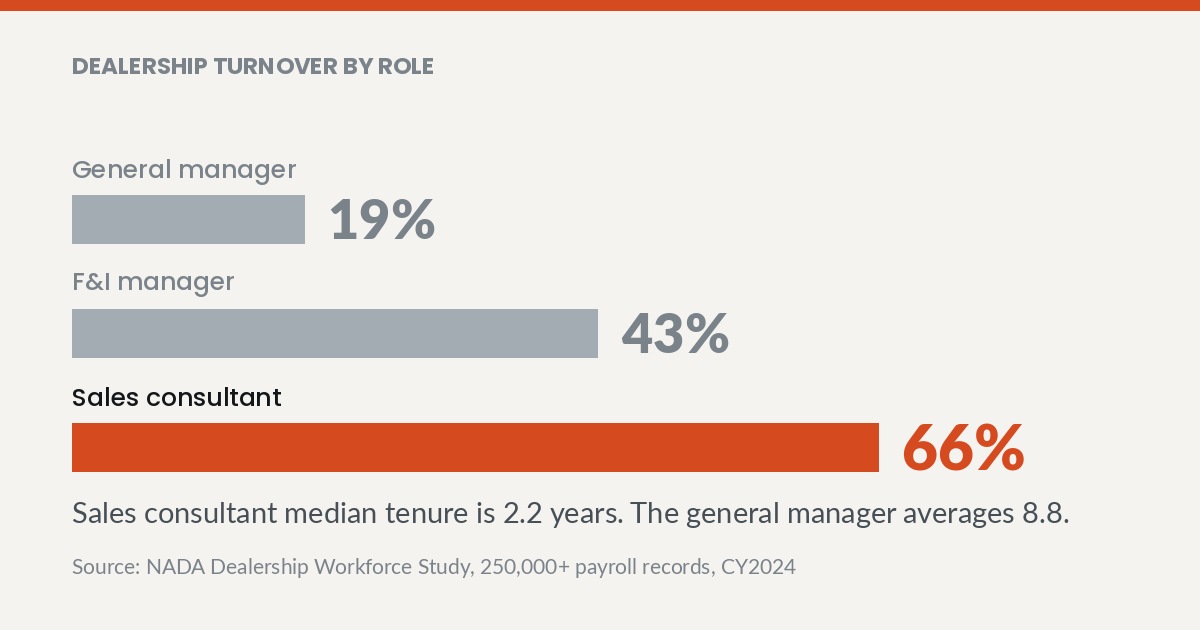
A car dealership consultant earns the engagement by diagnosing which role is bleeding, not by retraining the sales floor again. The NADA Dealership Workforce Study for CY2024 puts sales consultant turnover at 66 percent against 19 percent for general managers. That spread sits inside one building, under one owner, in one labor market. It points at role design.
The spread inside one building is the diagnostic
The NADA Dealership Workforce Study for CY2024 drew on more than 250,000 payroll records from 1,713 same-store dealerships. Total turnover across all positions came in at 42 percent, up 4 points. That headline number is the one most operators quote and the least useful one available.
The detail underneath it does the work. Sales consultant turnover reached 66 percent, up 12 points from 55 percent, the largest single jump in the study. Parts manager turnover was 13 percent, the lowest of any position tracked.
General manager turnover was 19 percent with median tenure of 8.8 years, according to the same study. The GM and the sales consultant work in the same building, sell the same brand, draw from the same applicant pool and answer to the same owner. One role holds people for the better part of a decade. The other cycles most of its staff annually.
Any explanation that reaches outside the dealership has to account for that gap. Wage inflation, a tight labor market and generational preferences apply equally to the parts counter and the showroom floor. They do not produce a spread this wide between two roles in the same store.
Retention collapses early and the median never recovers
The retention curve tells the story more precisely than the turnover rate does. NADA reported sales consultant one-year retention at 68 percent and three-year retention at 44 percent for CY2024, with median tenure of 2.2 years.
A store that hires ten consultants keeps most of them past the first anniversary and loses more than half by the third. The losses are not concentrated in a single bad cohort. They accumulate steadily across the window where a salesperson is finally becoming productive.
Productivity context makes that expensive. NADA Data for 2025 shows new vehicle sales per salesperson averaging 114 per year and used vehicle sales averaging 139. A consultant who separates near the median tenure delivers very little time at a seasoned output level, and none of it against the relationships that produce repeat business.
Recruiting cost is the visible loss. The larger one is the gap between hire and competence, paid twice, because the replacement starts the same ramp from zero. Stores that treat this as a recruiting problem buy more applicants and reproduce the outcome.
The labor market explanation does not survive the internal comparison
Turnover inside a dealership is not uniform, which is exactly why external causes fail as explanations. Service advisor turnover held at 43 percent and flat for CY2024, per NADA. F&I manager turnover was 43 percent, up 10 points, and sales manager turnover was 30 percent, up 6 points.
Those are four distinct trajectories in four departments sharing a parking lot. Flat, sharply up, moderately up and steeply up. A market-level cause produces market-level movement across all of them.
The comparison across store types points the same direction. NADA found non-luxury dealerships running 45 percent turnover against 30 percent at luxury stores for CY2024. Luxury and non-luxury stores in the same metro recruit from overlapping pools. What differs is pay plan structure, floor traffic quality, management ratio and the daily experience of the job.
Technicians offer the useful contrast
Service B-technician turnover was 31 percent with 3.2 year tenure, according to NADA for CY2024. Technicians face a documented national shortage, work physically demanding hours and hold portable credentials. Every condition that supposedly drives sales turnover applies to them with more force.
They still stay longer. The difference is that the technician role has a defined skill ladder, a certification path and compensation tied to measurable output that the technician controls. The sales role in most stores has none of those three.
Service advisors sit in the middle of that comparison and repay a closer look. Their turnover held flat while the sales floor jumped, and the advisor job carries a documented process, a repeating customer base and work that arrives on a schedule. Predictability is doing something here that pay alone does not explain.
What the sales role asks that other roles do not
The design problem is visible in the first ninety days of employment. A new consultant is placed on a variable pay plan before demonstrating any ability to earn on it. Income during the ramp depends on floor traffic the consultant does not control and on a sales process the consultant has not yet learned.
Compare that with the parts counter, where turnover sat at 13 percent. The parts role carries a defined scope, predictable pay and a supervisor who can evaluate performance against process compliance rather than closing rate alone.
The pay plan is the real job description
Pay plans in most stores are written to control cost and to reward top performers. They are rarely written to survive a productivity ramp. A consultant in month two is compensated as though month two and month twenty are the same job.
Gross per unit compression makes this worse than it was. When front-end gross narrows, a commission plan calibrated to older margins quietly reduces income for identical effort. The store reads that as a motivation problem. The consultant reads it as a pay cut and starts taking calls.
Onboarding is usually a schedule, not a program
Most stores hire against a vacancy rather than against a plan. The new consultant shadows for a week, completes manufacturer certification modules and is then handed to the floor. Nobody owns the ramp after that point.
A training program that ends when product knowledge is delivered has skipped the part that determines survival. Objection handling, follow-up discipline, customer satisfaction index behaviors and appointment setting are the skills that make month six survivable, and they take deliberate coaching to install.
The churn above the floor is the more serious signal
Sales consultant turnover gets attention because the number is large. The management figures deserve more concern than they receive. F&I manager turnover rose 10 points to 43 percent and sales manager turnover rose 6 points to 30 percent for CY2024, per NADA.
Those two roles are the natural promotion path for a productive consultant. When they churn, the career path a store offers becomes a claim it cannot demonstrate. A consultant weighing a two-year commitment looks upward and sees the same instability being sold as an opportunity.
Stable general management sitting on top of unstable middle management is a recognizable pattern. The owner sees continuity at the top and concludes the operation is sound. The layer that actually trains, coaches and schedules the sales floor is the layer coming apart.
Fixing this is management structure work rather than recruiting work. Defining spans of control, writing the coaching cadence into the sales manager role and separating deal desk duties from development duties are the changes that hold. Dealer groups without internal bandwidth for that redesign often bring in outside management consulting support to rebuild the role definitions before hiring against them again.
What changes the number
The interventions that move turnover are unglamorous and sequential. Define the sales role against a documented process before recruiting for it. Structure the pay plan so the first several months reward the behaviors that predict later production rather than the outcomes a beginner cannot yet produce.
Set scheduling that a person with obligations outside the store can sustain. Measure the ramp with the same seriousness applied to gross per unit. Track one-year retention as a management metric with an owner attached, not as a statistic reviewed each January.
Floor traffic quality belongs in the same conversation. A consultant judged on closing rate while receiving unqualified or poorly routed opportunities is being measured on something outside their control. Lead routing, appointment confirmation and desk support determine whether a new hire experiences the job as winnable.
Customer satisfaction index scores follow the same logic. Stores that churn the floor annually ask customers to build trust with someone who will not be there at the next service visit. The retention problem and the experience problem are one problem measured in two places.
Scale makes this worth solving. NADA Data for 2025 counts 16,990 franchised light-vehicle dealerships averaging $76,603,000 in annual sales. The sales floor is the primary revenue engine in an operation of that size, staffed by the least stable population in the building.
Sixty-six percent turnover is not a verdict on the workforce. It is a measurement of what a store asks a person to endure in exchange for uncertain income and an unclear path. The general manager stays 8.8 years because that role offers scope, stability and a future worth protecting. The consultant leaves because the role offers none of the three, and no amount of recruiting spend changes what the job is once someone accepts it.
Frequently Asked Questions
Is 66 percent sales turnover normal for the industry?
It is common, which is not the same as normal or acceptable. NADA reported sales consultant turnover at 66 percent for CY2024, up 12 points from 55 percent and the largest jump in the study. Rates that high are typical of stores that treat the sales role as an entry point rather than a career, and they are not uniform across store types. NADA found non-luxury dealerships at 45 percent overall turnover against 30 percent at luxury stores, which shows the number responds to how a store is run.
Should my store change the pay plan first or the training program first?
Pay plan design usually deserves the first pass because it governs whether a new hire survives long enough to benefit from training. A consultant leaving in the first several months over income uncertainty never reaches the point where coaching compounds. NADA reported one-year retention at 68 percent and median tenure of 2.2 years for CY2024, which locates the failure early. Training investment applied ahead of a pay plan fix is spent on people who will not be present to use it.
How do I know whether turnover is a market problem or a store problem?
Compare departments inside the same building before looking outside it. NADA data for CY2024 shows parts manager turnover at 13 percent and sales consultant turnover at 66 percent under identical local conditions. A genuine labor market effect would move those figures together rather than leaving a spread that wide. Any department significantly out of line with its peers inside the same store is describing its own role design.
What does high F&I and sales manager turnover indicate?
It indicates the promotion path is unstable, which undermines retention on the floor below it. NADA reported F&I manager turnover up 10 points to 43 percent and sales manager turnover up 6 points to 30 percent for CY2024. Consultants evaluating whether to stay assess the roles above them as evidence about their own future. A store cannot credibly sell a career path while the next rung keeps emptying.
What should a dealership measure to track progress on retention?
One-year retention is the single most useful figure because it captures the window where most separations occur. Median tenure by position gives the longer view, and NADA benchmarks such as 2.2 years for sales consultants and 8.8 years for general managers provide external comparison. Cost per hire and time to first delivery round out the picture on the recruiting side. Metrics without a named owner and a review cadence do not change behavior.
Can a smaller store afford to redesign the sales role?
The redesign is mostly management attention rather than capital. Writing a documented sales process, restructuring a pay plan around the productivity ramp and defining what a sales manager owes each consultant weekly cost time rather than money. Stores already carry the expense in recruiting, lost gross and customer satisfaction index damage from constant turnover. The relevant comparison is against the current cost of churn, not against zero.
No comments:
Post a Comment
Note: Only a member of this blog may post a comment.