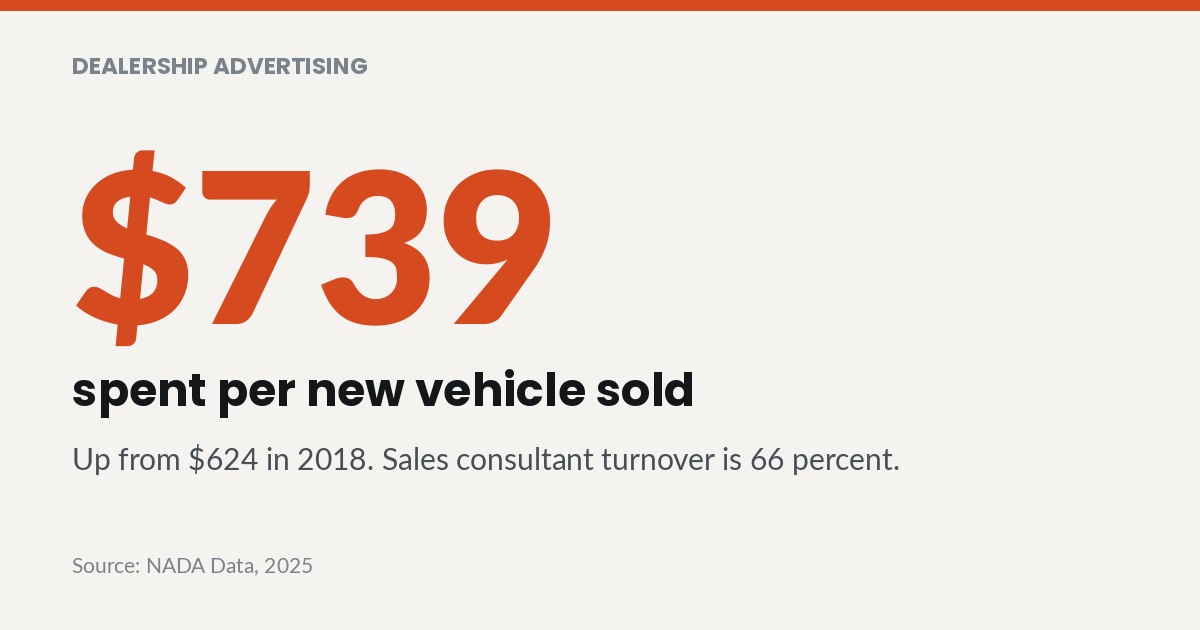
Auto dealer marketing has an allocation problem on the back end, not the front end. NADA Data for 2025 puts advertising expenditure at $739 per new vehicle sold, up from $705 in 2024. Those leads arrive at a sales floor with 66 percent annual consultant turnover. The spend is not the weak link, the handoff is.
The spend is at a record and the mix is defensible
NADA Data for 2025 puts advertising expenditure per new vehicle sold at $739, up from $705 in 2024 and $624 in 2018. Total dealership advertising expenditure reached $9.96 billion, averaging $586,246 per dealership. Neither figure suggests a dealer body that is underinvesting.
The channel allocation has modernized along with the buyer. NADA Data for 2025 breaks the advertising mix out by channel.
- Search engine marketing at 21.1 percent
- Third-party listing sites at 20.0 percent
- Search optimization and website at 19.5 percent
- Social at 14.2 percent
- Television at 10.5 percent
- Radio at 6.9 percent
- Direct mail at 5.6 percent
- Newspaper at 2.1 percent
In dollar terms per dealership, NADA Data for 2025 records $123,698 on search engine marketing, $117,249 on third-party listings and $114,318 on search optimization and website. Social absorbed $83,247 and television took $61,556 per store. Digital channels dominate, which is the correct answer given where shoppers begin.
The trajectory matters as much as the level. Advertising expenditure per new vehicle sold ran $624 in 2018 and $705 in 2024 before reaching $739 on NADA Data for 2025. Spend per unit has climbed steadily while the organization receiving those units has not become more stable.
A dealer reviewing that mix will find very little to cut. The problem is not that the money goes to the wrong channels. The problem is what happens after the channel does its job.
The receiving organization turns over every two years
The NADA Dealership Workforce Study for CY2024 covers more than 250,000 payroll records across 1,713 same-store dealerships. It puts sales consultant turnover at 66 percent, median tenure at 2.2 years and three-year retention at 44 percent. Total dealership turnover across all departments is 42 percent on the same study.
Those figures describe a sales floor where most people handling leads this quarter were not there two years ago. Product knowledge, process knowledge and customer relationships all reset at that rate. The advertising does not reset, it keeps arriving at the same speed.
A lead is a perishable asset that requires a trained human to convert. Routing a record-level advertising budget into a workforce that replaces itself every couple of years is a design decision, whether or not anyone made it deliberately. The cost shows up as leads that never receive a second contact.
What turnover does to a lead in practice
Turnover damages lead handling in ways that never appear in a marketing report. A new consultant does not know the inventory well enough to answer a specific question quickly. Response time slips, and the shopper who submitted three inquiries buys from whichever store answered first.
Process discipline is the second casualty of churn. Customer relationship management systems only work when the people entering data believe the data matters. A consultant early in a job that most people leave inside three years enters what is required and nothing more.
Follow-up is the third casualty and the most expensive. Sold and unsold follow-up sequences depend on ownership of a customer over months. Turnover breaks that ownership, and orphaned records sit in the system as evidence that the advertising worked and the process did not.
Managers absorb the difference by working the floor themselves. That is a common response, and it caps the store at whatever the manager can personally handle. The advertising budget scales, and the human capacity behind it does not.
Digital retailing tools were supposed to reduce the dependence on floor talent. In practice they move part of the transaction online and hand the remainder back to the same consultant. A shopper who configures a deal online and then meets an untrained salesperson experiences the discontinuity as a broken store.
The per-salesperson math makes the exposure visible
NADA Data for 2025 puts new vehicle sales per salesperson at 114 per year and used at 139. Those are the units carrying the advertising spend. A store losing a consultant loses a share of that production while the replacement learns the job.
The transaction values involved raise the stakes considerably. NADA Data for 2025 records an average new vehicle retail selling price of $48,205 and an average used price at franchised dealerships of $28,680. Every mishandled lead is a transaction of that size that went somewhere else.
Store-level economics make the same point at scale. NADA Data for 2025 puts average dealership sales at $76,603,000, with a revenue mix of 54.9 percent new, 31.8 percent used and 13.3 percent service and parts. A store of that size runs on process rather than on individual talent.
The industry is large enough that the pattern is structural rather than local. NADA and BLS figures for 2025 count 16,990 franchised light-vehicle dealerships employing 1,123,100 people, averaging 65 per store. A store of that headcount cannot rely on informal knowledge transfer to protect its lead flow.
Cost per sale is the number that connects the two halves of the problem. A store can compute it from its own advertising spend and its own delivered units without any industry data. Watching that figure move as lead handling improves tells a dealer more than any channel report will.
Fixed operations shows what a retained relationship is worth
The service drive offers a useful contrast here. NADA Data for 2025 shows dealerships wrote 16,252 repair orders each, generating $9,687,942 in service and parts sales at $494 per customer repair order. That revenue comes from customers the store already acquired.
Service and parts contributes 13.3 percent of revenue on the NADA mix while generating a far more durable customer relationship. The department runs on appointment discipline, capacity planning and follow-up, which are exactly the practices the sales floor struggles to maintain. The difference is staffing stability rather than channel strategy.
Retention economics also explain why service traffic is worth protecting during a sales downturn. A customer retained in service returns on a defined cadence with no advertising spend attached to the visit. Sales acquisition, by contrast, restarts from zero on every single deal.
A dealer looking for a template for lead handling has one inside the building. Service advisors work a structured process with defined touchpoints and measured outcomes. The sales department buys traffic at $739 a car and then handles it with far less structure.
Fixing the handoff instead of the media plan
The fix is unglamorous and it is not a vendor purchase. A dealership with 66 percent sales turnover has to build a process that survives the person executing it. That means the process has to be written, trained and measured rather than transmitted informally.
Response time as a managed metric
Speed to first contact determines which store gets the appointment. A store measuring response time by lead source, by hour and by individual has something it can manage. A store measuring monthly averages has a number that hides every failure inside it.
Appointment set rate before close rate
Close rate is a lagging measure that mixes lead quality with sales skill. Appointment set rate isolates the part of the process the store actually controls. Dealers tracking set rate by source can tell whether the money bought bad leads or the floor handled good ones badly.
Onboarding built for a workforce that turns over
With median sales consultant tenure at 2.2 years on the NADA study, onboarding is a permanent function rather than an occasional event. A store that gets a new consultant productive in weeks instead of months recovers a large share of the turnover cost. Training built once and delivered continuously outperforms training assembled each time someone quits.
Lead ownership that survives a departure
Most stores assign a lead to a person and lose the thread when that person leaves. Assigning leads to a queue with a named owner and a documented reassignment rule keeps the record alive. With turnover at 66 percent on the NADA study, reassignment is a routine event rather than an exception.
Attribution deserves a discipline of its own inside the store. A store that cannot connect a sale back to a lead source is guessing at $586,246 of annual spend. Dealers who want that connection built properly often start with a management consulting engagement covering sales process and operations rather than another marketing vendor.
The advertising number and the turnover number belong in the same conversation. NADA Data puts the spend at $739 per new vehicle sold, and the NADA Dealership Workforce Study puts sales consultant turnover at 66 percent. Reviewing one without the other produces a media plan and no improvement.
Dealers have spent years optimizing the top of the funnel with genuine skill. The mix is modern, the budgets are serious and the channels are measured. What remains unoptimized is the moment a lead becomes a specific person's responsibility, and that moment decides the return on every advertising dollar.
Frequently Asked Questions
Is my dealership spending too much on advertising?
The spending level at most stores sits close to industry norms rather than above them. NADA Data for 2025 puts advertising expenditure at $739 per new vehicle sold and $586,246 per dealership on average. A store materially above those figures should examine its channel mix, and a store well below them should examine its market coverage. The more productive question is what happens to the leads that spend generates.
Which advertising channels deliver the best return for a dealership?
Channel performance depends on the store, the brand and the market rather than on a universal ranking. NADA Data for 2025 shows the industry mix at 21.1 percent search engine marketing, 20.0 percent third-party listing sites and 19.5 percent search optimization and website. Those three channels dominate because shoppers begin there. No store can answer the return question without attribution connecting closed sales back to source.
How much does sales turnover actually cost a store?
The cost appears as lost production rather than as a recruiting line item. NADA Data for 2025 puts new vehicle sales per salesperson at 114 per year and used at 139. A vacancy or a ramping replacement removes a share of that production while advertising spend continues unchanged. The NADA Dealership Workforce Study puts sales consultant turnover at 66 percent with median tenure of 2.2 years.
Should a store fix lead handling before increasing the marketing budget?
Extra spend poured into an unchanged process produces proportionally more waste. A store should confirm that response time, appointment set rate and follow-up completion are measured and acceptable first. Once those are stable, additional advertising converts at a known rate rather than an assumed one. The sequence protects the incremental budget from the bottleneck that already exists.
What should my store measure to know the lead process is working?
Response time to first contact, appointment set rate by source and appointment show rate cover most of it. Those three measures isolate the part of the funnel the store controls, separate from lead quality. Close rate matters but arrives too late and mixes too many variables to direct daily behavior. Each measure should be visible by individual and by lead source rather than as a store average.
How does fixed operations relate to the marketing problem?
Service demonstrates what a structured process produces with the same customer base. NADA Data for 2025 shows dealerships wrote 16,252 repair orders each, generating $9,687,942 in service and parts sales at $494 per customer repair order. That revenue comes from customers already acquired and retained through defined appointment and follow-up processes. Sales departments that borrow that structure convert more of the traffic advertising has already bought.
No comments:
Post a Comment
Note: Only a member of this blog may post a comment.